
Pelvic floor physio in Barcelona
Leaking when you cough or run, pain during sex, a feeling of heaviness low in your tummy: pelvic floor problems are common, but they are not normal. I see you in Barcelona, in the Eixample, to understand what is happening and to treat it, at your own pace.
Is this for me?
The three most common reasons. Choose the one that sounds like you.
I leak when I cough, laugh or run
Stress urinary incontinence
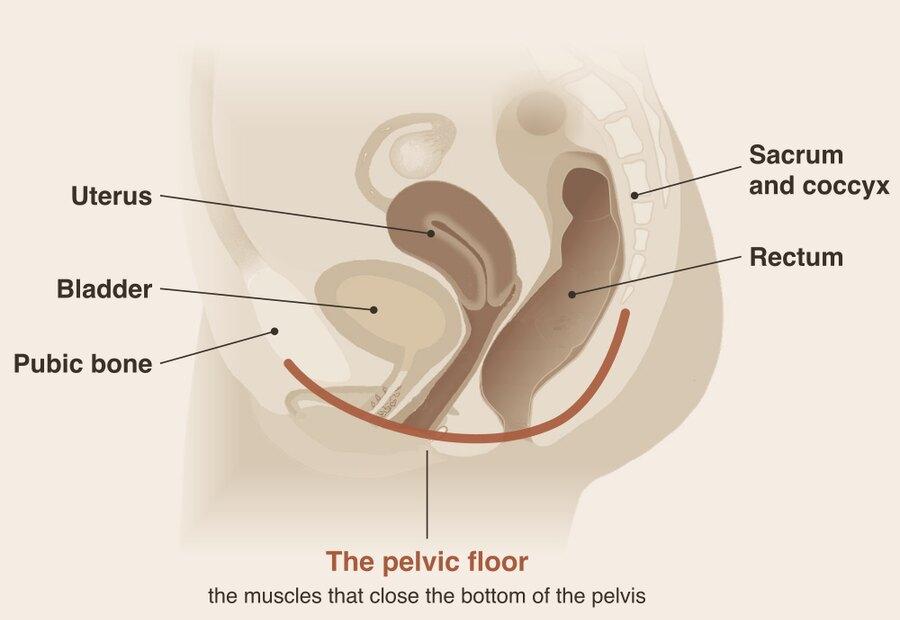
Pressure rises in your tummy and the pelvic floor no longer closes the urethra (the tube that carries urine out) firmly enough. We start by learning to tighten it just before you cough or make an effort.
Read the article →I want to get back to sport without leaking or doing damage
Returning to sport
With every impact, pressure rises in your tummy and the pelvic floor has to absorb it. We prepare it step by step, right up to the movements of your sport.
Read the article →Sex is painful
Dyspareunia
The pain can have several causes: muscles that do not relax, a scar, tissues that have become fragile. We start by relaxing, gently and at your pace.
Read the article →The 15 other situations
The three reasons women most often come to see me: recovering after a birth, wanting to get back to sport, and pain during sex.
You may also recognise yourself in one of these. Choose the one that sounds like you.
I always need a wee and I can’t hold it
Overactive bladder
The bladder sends its signal in several stages. With an overactive bladder, the urge is pressing from the very first signal and waiting becomes hard. We start by looking at your habits: what you drink, and when you go to the toilet.
Read the article →I can feel a heaviness, a bulge in my vagina
Prolapse (pelvic organ prolapse)
The muscles and tissues that support the bladder, uterus or rectum have stretched. We strengthen the pelvic floor and you learn to manage pressure in everyday life.
Read the article →Penetration is impossible or very painful
Vaginismus
The muscles around the vagina tighten without you deciding to. We start with breathing and relaxation; nothing happens without your agreement.
Read the article →My vulva burns for no reason
Vulvodynia
It is lasting pain in the vulva with no visible cause; nerves and muscles can play a part. We first aim to relax the pelvic floor and calm the area.
I can’t hold in wind or stools, or I’m constipated
Faecal incontinence, bowel problems
Holding in means tightening, emptying means relaxing: one of the two no longer works well. The assessment shows which one; we work on that, and on how you sit on the toilet.
Read the article →My pelvic floor is too tight, or I feel nothing when I squeeze
Overactive (hypertonic) or weak (hypotonic) pelvic floor
A pelvic floor that is too tight can no longer relax; one that is too weak no longer contracts enough. The assessment shows which is yours: we relax the one, we strengthen the other.
Read the article →It feels open down there, as if air gets in
Vaginal laxity
After a birth, the pelvic floor muscles can stay stretched and the entrance to the vagina closes less well. We start by helping you feel the contraction, then we strengthen.
My tailbone hurts when I sit
Coccydynia
When you sit, part of your weight rests on the tailbone (coccyx), where some pelvic floor muscles attach. After a fall or a difficult birth, it can stay painful. We first look for where the pain comes from: posture, a fall, muscles that are too tight.
Read the article →My pubic bone hurts when I walk or turn over in bed
Symphysis pubis pain (SPD)
During pregnancy, the joint at the front of the pelvis becomes more mobile and more sensitive. We start with manual therapy, sometimes a technique that draws the pelvis together and can bring relief, then stabilising exercises.
Read the article →I push down when I breathe and my tummy bloats
Abdominal and pelvic floor dysfunction
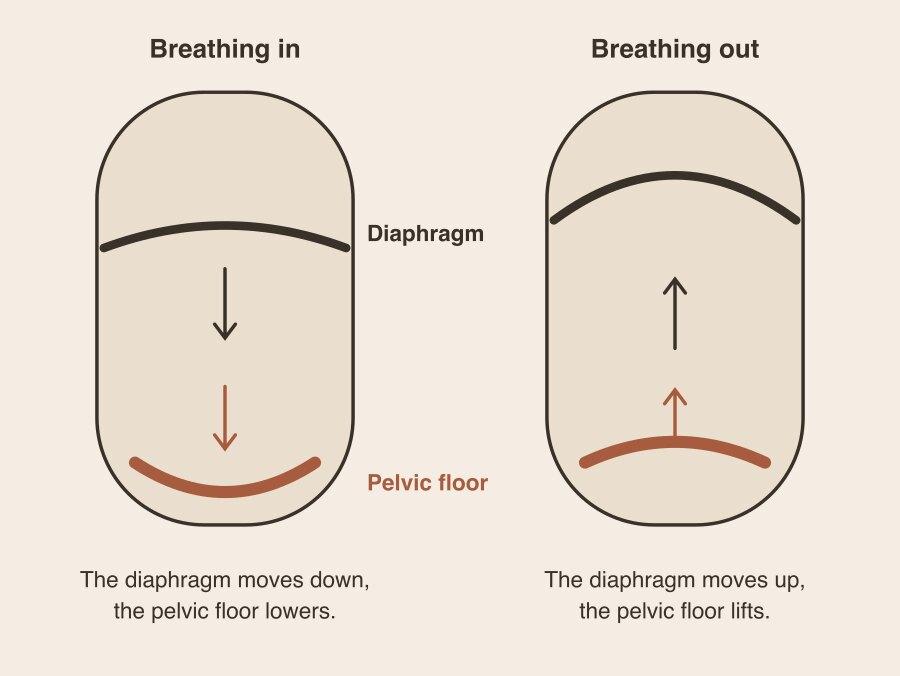
The diaphragm, the tummy muscles and the pelvic floor work together with every breath. We start with breathing and posture, so that the pressure no longer pushes downwards.
My pelvic floor is weaker than before, it doesn’t feel the same
Menopause and perimenopause
As oestrogen falls, the tissues of the vulva, vagina and bladder become thinner and drier. We take stock of your pelvic floor, then we keep it in shape; it is never too late.
My libido has dropped, I’m dry, I don’t feel like myself
Sexual difficulties
Dryness often comes from the drop in oestrogen; desire depends on many other things. We talk about it openly, and I refer you on if another professional can help you better.
Read the article →Does this sound like you? The one-hour assessment is there to understand what is happening.
You’re young and haven’t had children?
Leaking, needing the toilet too often, pain during sex or vaginismus can affect you too. These treatments are for you.
Years have passed since your birth, or you’re through the menopause?
It is never too late for pelvic floor or tummy muscle rehab, even if you have done it before.
You’re pregnant?
You are welcome: before the birth is a good time to become aware of your pelvic floor, your posture and your breathing.
For this treatment I see women only.
The first session
1 hour · €85
It is an assessment: I listen to you, I explain, then I examine you. Nothing happens without your agreement.
We talk
I tell you how the session will go, then I listen: what brings you here, since when, and what you hope for.
Read more
I then ask a few questions about your history, because it matters for the pelvic floor: pregnancies and births, menopause, operations, falls on the tailbone, and also your sport, your work, your bladder and your bowels. Your sex life only if you wish to talk about it.
We fill in a questionnaire
Its score is the starting point for following your progress through the treatment.
Read more
It covers the bladder, the bowel, support of the organs and sexuality, and I tell you the reason for each question.
I explain
So that you understand the treatment and take part in it, I show you what is happening in your body: how the pelvic floor works with the tummy muscles and the diaphragm, and the part posture plays.
I examine you
I first look at your posture, your breathing and your tummy muscles, then your pelvic floor. The pelvic floor exam is external, and internal only if you agree. The decision is yours: you can put it off, decline it or stop it at any moment.
Read more
Without an internal exam, I can still assess your pelvic floor, from the outside and through the questionnaire.
At the end of the assessment
You leave with a treatment plan made for you and starting measurements, to follow your progress:
- the strength of your pelvic floor, scored from 0 to 5, its endurance and its quick contractions (PERFECT score, Oxford scale);
- your questionnaire score;
- the measurement of your diastasis if you have one, that is, the gap between the two surface muscles of the tummy.
What to bring
- Come in comfortable clothes: something loose or sportswear.
- Bring a bottle of water if you like. Everything else is provided.
- It is best to come when you are not on your period, at least for this assessment.
- Your baby is welcome.
5.0 · 31 reviews on Google (in French)
« Cinq séances avec Julie quelques mois après l'accouchement. Attentive, professionnelle, adorable. Vraiment une belle expérience. »
« Très compétente et pleine d'attention. Dès la première séance, elle a pris le temps de comprendre mes douleurs. »
After the first session
How often, exercises at home, the end of treatment
The pace adapts to you. After a birth, I often suggest two sessions a week for a month, then one. At the menopause, more often one session a week. Follow-up sessions last 45 minutes.
I do not set a number of sessions in advance: every situation is different. At the fifth session, we do a new assessment. Sometimes it is the last one, because you are well. If not, it tells us what is left to do.
- At home: around ten minutes of exercises a day at first; three thirty-minute sessions a week once we see each other less often.
- A little equipment is enough: a mat, a small ball, a resistance band. Many exercises can also be done sitting or standing, during a break or while your baby naps.
- I send you your exercises by message, as a document or by email. You can film yourself: I correct you between sessions.
- Between sessions, you can write to me on WhatsApp. I reply within 24 hours.
The treatment is finished when your goals are reached and you know how to keep up on your own what you have gained. You can come back whenever you feel the need.
How I treat
Depending on what the assessment showed: stress incontinence, painful sex, prolapse, returning to sport
The treatment depends on what the assessment showed. A pelvic floor that is too weak and one that is too tight are not treated the same way.
- Stress urinary incontinenceLeaking when you cough, laugh or run
- We strengthen your pelvic floor, for strength and endurance (Kegel exercises). You learn to tighten it just before you cough or make an effort. We also work on the transversus (the deep tummy muscle), breathing and posture.
- DyspareuniaPain during sex
- The first aim is to relax the pelvic floor; strengthening comes afterwards, if needed. We start with breathing and releasing the diaphragm, then manual therapy and a gentle, gradual massage. I also work on any scars.
- ProlapseA dropped organ: a heaviness, a bulge in the vagina
- We strengthen the pelvic floor, and you learn to manage pressure through breathing, posture and the transversus. I give you advice for everyday life and, depending on the stage, I refer you to your gynaecologist.
- Hypertonic pelvic floorA pelvic floor that is too tight and no longer relaxes
- Above all we relax, through breathing, manual therapy and visualisation. No strength training at first.
- Hypotonic pelvic floorA pelvic floor that is too weak and no longer contracts enough
- First you learn to feel it, then we strengthen it little by little.
- Returning to sportRunning, jumping, lifting again, without leaking
- We carry the same groundwork through to the impacts and movements of your sport, to check that there is no more leaking.
I use some tools only when they are useful to you:
- Electrical stimulation of the pelvic floor, when it is weak or you cannot manage to contract it.
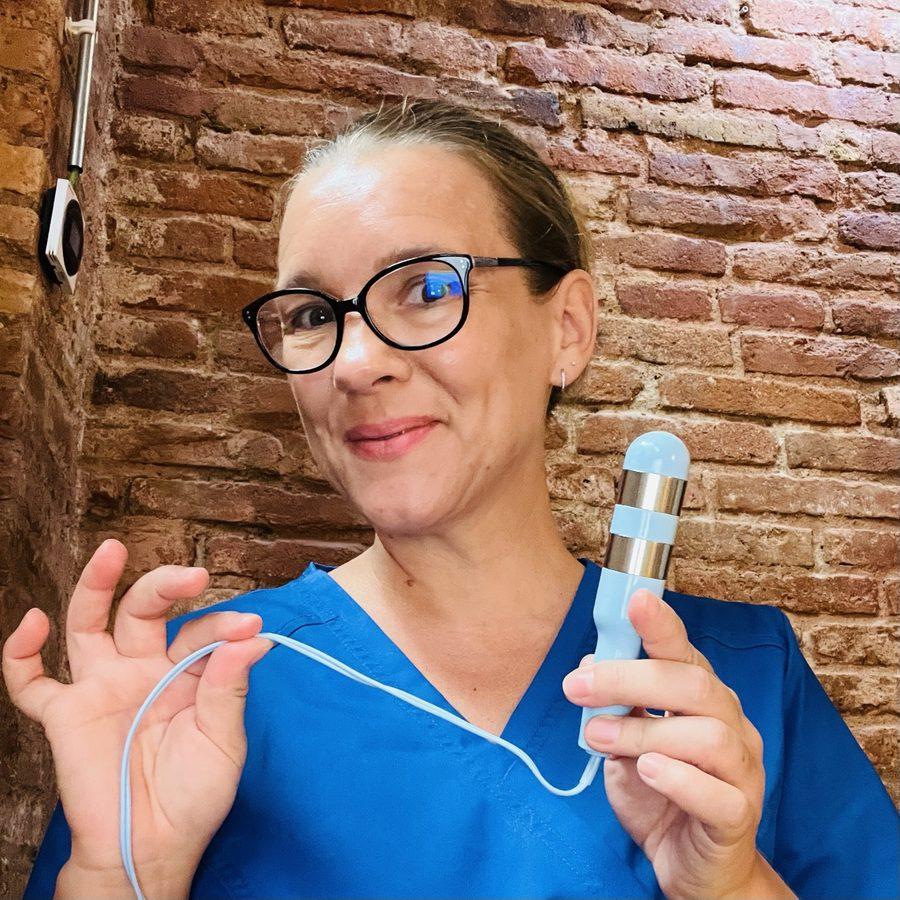
- Biofeedback, to see your contraction on a screen and learn to feel it.
- Radiofrequency (Indiba): a gentle, deep warmth, to loosen the tissues and ease pain.
- Hypopressives, alongside, for posture, breathing and the deep tummy muscles.
Pelvic pain has different causes from one woman to another. Pain that comes from a pelvic floor that is too tight, from vaginismus, or from an episiotomy or tear scar is a matter for physiotherapy. For the rest, I refer you to the right professional.
To protect your pelvic floor day to day, I also give you some pointers: how to sit on the toilet, not straining, drinking enough, breathing in and tightening before you cough or lift.
When it is not suitable
After a birth or an operation, the signs that need a doctor first
- After a birth, I see you for an assessment whenever you wish; the internal examination waits until four weeks after the birth.
- After an operation, with your surgeon’s agreement. If you have an infection, once it has been treated.
- The internal examination and electrical stimulation are not done if you have an infection.
- Unexplained bleeding, fever, sudden severe pain, blood in your urine or stools, a sore or an unusual-looking patch on the skin or the lining of the vagina: see your doctor first.
- Electrical stimulation and radiofrequency are not used during pregnancy or with a pacemaker. Hypopressives are not done during pregnancy or if you have a heart problem.
- I do not make medical diagnoses: I work with your doctor, your midwife, your gynaecologist. When a difficulty goes beyond my field, I refer you to the right professional: a doctor, psychologist, psychiatrist or sex therapist.
- I do not do home visits.
Prices, insurance, address
€85 for the assessment, €75 for follow-ups · no referral needed · Carrer del Bruc 145
- First session, assessment
- 1 hour · €85
- Follow-up session
- 45 minutes · €75
Do I need a referral? No. You can book directly, without going through your GP.
What about insurance? I work privately, outside insurers’ networks. You pay for the session and I give you an invoice. Your private or international health insurance then reimburses you in full, in part or not at all: it depends on your policy. Before you come, ask your insurer three questions:
- Do you cover a physiotherapist outside your network (in Spain: fuera del cuadro médico)?
- Up to what amount per session?
- For how many sessions a year?
Carrer del Bruc 145, 08037 Barcelona (Eixample). Monday to Friday, 9am to 8pm. I see patients in French, Spanish, English and Portuguese.
How I work
Nothing without an explanation, nothing without your consent · my training
- I explain each step before I do it, and I do nothing without your agreement. You can withdraw it at any moment.
- The session is a place to be listened to: your experience, what you feel, your fears. Openly, and with respect for your privacy.
- We always start gently. Then we progress together.
- Every body is different: the treatment adapts to your age and your history.
- What is said in a session stays confidential.
- I remain available if you need support or motivation.
- I offer nothing revolutionary: techniques learnt through my training and my years of experience, adapted to each patient, and grounded in research.
- Physiotherapy degree, ISEK, Brussels (2004)
- Master’s in pelvic floor rehabilitation, Spain (2023)
- Low Pressure Fitness certification, hypopressives (2020)
- Registered with the Col·legi de Fisioterapeutes de Catalunya, no. 18060
- Twenty years of practice in France, Belgium, Brazil and Spain
Frequently asked questions
Does it hurt? Is the internal exam compulsory? How many sessions?
- How much does a pelvic floor physio session cost?
- The first session lasts an hour and costs €85. Follow-up sessions last 45 minutes and cost €75.
- Do I need a referral? Is it covered by insurance?
- No referral is needed. I work outside the networks of all insurers, Adeslas and Sanitas included. You pay for the session, I give you an invoice, and your health insurance reimburses you according to your policy. Ask your insurer whether it covers a physiotherapist outside its network, up to what amount, and for how many sessions a year.
- Midwife or physio: who does pelvic floor rehab?
- In France, either a midwife or a physiotherapist can do it after a birth. I am a physiotherapist with a master's in pelvic floor rehabilitation, and I work with your midwife.
- Does it hurt?
- No, the sessions are not meant to hurt. You can say what you feel at any moment and stop an exercise or an exam. The aim is to bring relief, including from pain.
- Is the internal exam compulsory?
- No. It is done only with your agreement, and I can assess your pelvic floor in other ways.
- Do you use a probe? Do I need to buy one?
- Not routinely. The probe is used only for electrical stimulation or biofeedback, when they are useful. In that case, I can supply it at market price, or give you the model if you prefer to buy it yourself. It is personal: you keep it and use it for the whole treatment.
- How many sessions will I need?
- I do not set a number in advance. We review your progress at the fifth session; sometimes it is the last.
- Does the probe have side effects?
- They are rare and minor: some discomfort while the probe is in place, sometimes vaginal discharge. The trials reported no serious effects. Tell me what you feel: we stop or do it differently.
- How long before I see results?
- It depends on each situation, and I do not promise a timeframe. We measure your progress with the same figures as at the assessment, and we review it at the fifth session.
- I have a prolapse: can I avoid surgery?
- I cannot promise that. Rehab improves prolapse symptoms; the decision to operate is made with your gynaecologist, depending on the stage. For a stage 1 or 2 prolapse that bothers you, UK guidelines advise considering at least sixteen weeks of supervised rehab first, with or without a pessary. Surgery is offered if the symptoms do not improve.
- I’m leaking during pregnancy: can I come?
- Yes. In women who do not leak, training the pelvic floor during pregnancy probably reduces the risk of leaking late in pregnancy. When the leaks are already there, trials do not yet show a clear effect during pregnancy; the assessment tells us where to start. Electrical stimulation, radiofrequency and hypopressives are not used during pregnancy.
- My pelvic floor still hurts after giving birth: can you help?
- Yes. An episiotomy or tear scar, muscles that have stayed too tight, or the tailbone can be the cause, and physiotherapy treats this pain; I also work on scars. I see you for an assessment whenever you wish; the internal examination waits until four weeks after the birth. See your GP or midwife first if you have a fever, or if the scar becomes redder, more painful and swollen, or oozes pus. For a painful caesarean scar, there is an article on the Pregnancy and postnatal page.
- Sex is painful and I’m bleeding: what should I do?
- Unexplained bleeding needs a medical opinion first. See your doctor or gynaecologist, then together we will look at what physiotherapy can help with.
- I have endometriosis and painful sex: can you help?
- Endometriosis is treated with your gynaecologist. It often comes with a pelvic floor that is too tight, and that part of the pain is what physiotherapy works on. In one trial, five sessions reduced pain on penetration and slightly reduced pelvic pain; they did not change bladder, bowel or sexual function.
- Will I have exercises to do at home?
- Yes: around ten minutes a day at first, with a little simple equipment. I send you your exercises by message, as a document or by email. The article on Kegel exercises explains how to find and tighten the right muscles.
- Can I message you between sessions?
- Yes, on WhatsApp, for the whole of your treatment. I reply within 24 hours.
- I’m young and haven’t had children: is this for me?
- Yes. Leaking, needing to wee too often, pain during sex or vaginismus can affect young women who have never had children.
- Is it too late, years after giving birth or at the menopause?
- No, it is never too late. Even if you have already had pelvic floor rehab and your symptoms come back, it is always worth seeing someone, whatever your age.
- Can I come during my period? With my baby?
- It is best to avoid your period for the first session. Your baby is welcome.
- Do you treat men?
- For pelvic floor rehab, I see women only.
What the research says
Four key studies, what they show and what they do not
Pelvic floor rehabilitation is one of the best-studied treatments in physiotherapy. Here are the key studies, with what they show and what they do not.
The review brings together 31 trials and 1,817 women. In the four trials that measured cure of stress leaks (165 women), 56% of those who trained their pelvic floor reported being cured, against 6% with no treatment. Follow-up rarely goes beyond a year.
Dumoulin C, Cacciari LP, Hay-Smith EJC. Pelvic floor muscle training versus no treatment for urinary incontinence in women. Cochrane Database of Systematic Reviews, 2018.
A trial run across several centres. Individual pelvic floor rehab improves prolapse symptoms. The long-term benefit has yet to be established.
Hagen S et al. Individualised pelvic floor muscle training in women with pelvic organ prolapse (POPPY). The Lancet, 2014.
46 trials, 10,832 women. In women who do not leak, training the pelvic floor during pregnancy probably reduces the risk of leaking late in pregnancy, and slightly three to six months after the birth. In women who already leak, no effect has been shown.
Woodley SJ et al. Pelvic floor muscle training for preventing and treating urinary and faecal incontinence in antenatal and postnatal women. Cochrane Database of Systematic Reviews, 2020.
94 women followed for a year. Hypopressives, pelvic floor training and the two combined all improve symptoms. Other trials find pelvic floor training more effective (Resende et al., 2019; Jose-Vaz et al., 2020). I use hypopressives alongside it.
Navarro-Brazález B et al. Effectiveness of hypopressive exercises in women with pelvic floor dysfunction. Journal of Clinical Medicine, 2020.