
I can feel heaviness, a bulge in my vagina
This feeling has a name: prolapse, when a pelvic organ drops. Pelvic floor physiotherapy improves the symptoms. Whether to have surgery is decided with your gynaecologist, depending on the stage.
What is happening
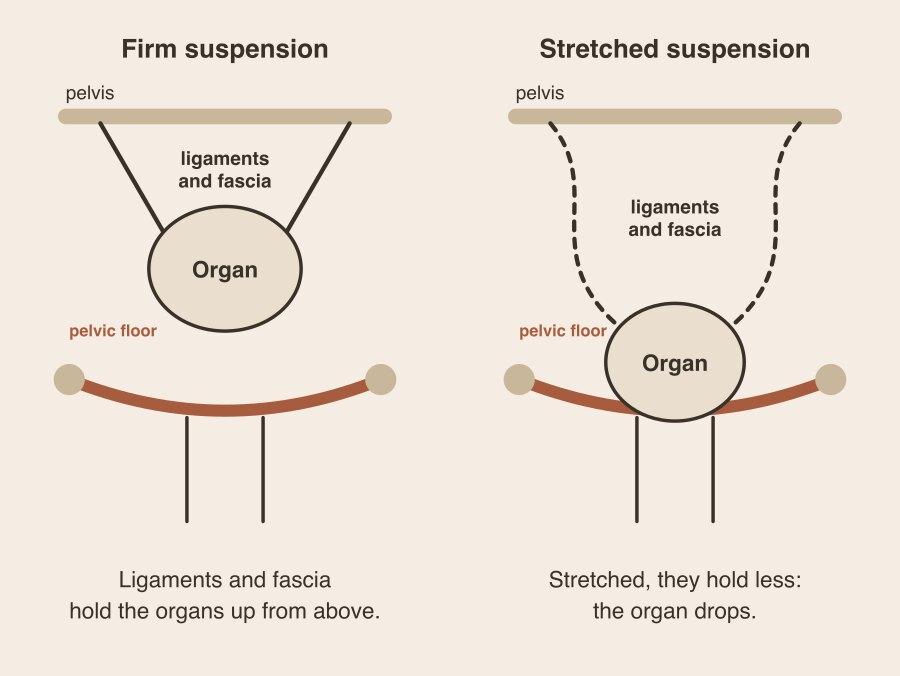
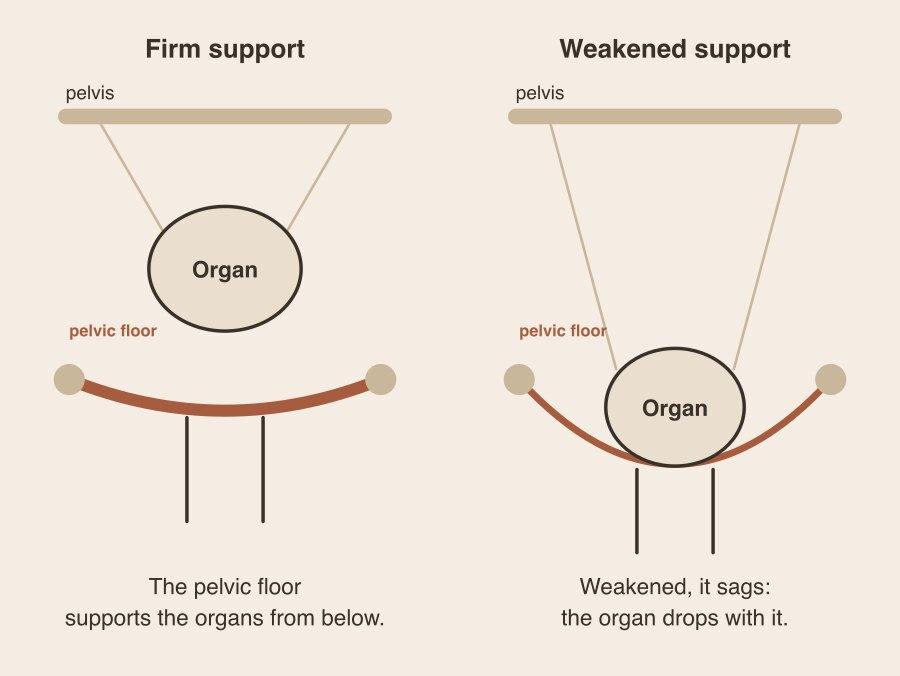
The bladder, uterus and rectum are held in place by muscles and tissues. When this support stretches, an organ drops and presses on the wall of the vagina. The best-established factors are vaginal birth, age and weight; pushing often and hard also plays a part.
How to recognise it
A heaviness low in your tummy, a bulge you can feel at the entrance of your vagina. Only the bulge is specific to prolapse: the other signs can have other causes, which is why an examination matters.
The stage says how far the organ has dropped, measured from the entrance of the vagina: at stage 1, it stays more than a centimetre above it; at stage 2, it reaches the entrance, within a centimetre; at stage 3, it comes out more than a centimetre beyond it; at stage 4, the vagina has come out almost completely.
What you can do today
- Don't push or strain on the toilet.
- Lift without holding your breath: breathe out as you make the effort.
When to seek help
As soon as you feel this bulge or heaviness. Your gynaecologist determines the stage; I work alongside them.
See your doctor first if you have unexplained bleeding, a fever or a sore on the bulge.
Rehab, pessary or surgery?
For a stage 1 or 2 prolapse that bothers you, UK guidelines advise considering at least sixteen weeks of pelvic floor rehab first, supervised by a professional. A pessary can also be considered, on its own or with rehab. Surgery is offered if the symptoms do not improve with these treatments, or if you do not want them. The decision is made with your gynaecologist.
How I treat it
Strengthening the pelvic floor, for both strength and endurance. Managing pressure through breathing, posture and the transversus (the deep tummy muscle). Advice for your everyday movements. Hypopressive exercises can be added alongside.
Pelvic floor physiotherapy: the first session, prices, my methods →
What the research says
Prolapse is a descent of the bladder, uterus or rectum, linked to stretched support (Jelovsek et al., The Lancet, 2007). In a multicentre trial, one-to-one pelvic floor physiotherapy improved symptoms; the long-term benefit has yet to be established (Hagen et al., The Lancet, 2014). Your gynaecologist may also suggest a pessary (a device placed in the vagina to support the organ) or an operation (Jelovsek et al., 2007). UK guidelines advise considering at least 16 weeks of supervised rehab as the first treatment for a bothersome stage 1 or 2 prolapse, a pessary alone or combined, and surgery when symptoms do not improve or the woman declines non-surgical treatment (NICE NG123, 2019). The stages follow the POP-Q system, measured from the entrance of the vagina (Persu et al., Journal of Medicine and Life, 2011).