
Pregnancy and postnatal physiotherapy in Barcelona
A back that aches during pregnancy, a perineum to prepare before the birth, a caesarean scar that stays hard, a gap between your tummy muscles after the birth. I see you in Barcelona, in the Eixample, before and after the birth, at your own pace.
Is this for me?
I'm pregnant and I want to get my pelvic floor ready for the birth
Perineal preparation, perineal massage
At birth, the baby's head stretches the muscles and skin of the perineum, the area between the vagina and the anus. I teach you to feel your pelvic floor, then the massage, inside and outside the vagina.
Read the article →My lower back has hurt since my bump started growing
Lower back pain in pregnancy
Your ligaments soften, your weight goes up and your centre of gravity moves forward: the curve in your lower back deepens. The session combines manual therapy, mobility work and tools to ease the pain at home.
See how I treat →I have a pain that starts in my bottom and runs down my leg
Sciatica in pregnancy
The sciatic nerve starts in the lower back and runs through the buttock down the leg; when it is irritated, it causes this pain. We start as we would for the lower back: manual therapy, mobility work and tools to ease the pain at home.
Read the article →The 9 other situations
This page follows a path: pregnancy, preparing for the birth, the weeks after your baby arrives, getting back to activity. Leaks, a feeling of heaviness and pain during sex are explained on the “Pelvic floor physiotherapy” page.
You are pregnant, or you have had your baby. Choose the sentence that sounds like you.
My pubic bone or pelvis hurts when I walk or turn over in bed
Pelvic girdle pain
During pregnancy, the joints of the pelvis, at the front (the pubic bone) as well as at the back, become more mobile and more sensitive. We start with manual therapy techniques, sometimes a pelvic compression technique, which can ease the pain, then stabilising exercises.
Read the article →I don't know how to breathe or push on the day
Physical preparation for the birth
Your diaphragm, tummy muscles and pelvic floor work together with every breath. The preparation covers different ways of breathing, mobility, relaxation and awareness of your pelvic floor.
See how I treat →My legs and ankles are swelling
Swelling in pregnancy (oedema)
During pregnancy, your body holds on to more water than usual; as the day goes on, it settles in your legs and feet. I offer manual lymphatic drainage, the Leduc method.
Read the article →I've had my baby and I don't know what state my pelvic floor and tummy are in
Postnatal assessment
The pelvic floor is weakened during pregnancy, and above all by the birth; your tummy muscles have stretched around the baby. We start with a one-hour assessment: your history, a questionnaire with a score, then an examination of your tummy muscles and pelvic floor.
Read the article →I had a caesarean. My scar pulls, it's hard, I can't feel it any more
Caesarean scar
Discomfort around the scar is a common after-effect of a caesarean; for some women it stays stiff or painful for months. Depending on the assessment: scar massage, tissue mobilisation, radiofrequency (Indiba) if needed.
Read the article →I had an episiotomy or a tear. The scar hurts
Perineal scar
The scar lies in the perineum, between the vagina and the anus; it can stay tender, pull, or make sex painful. We start with the scar, gently: massage and tissue mobilisation.
Read the article →My tummy hasn't closed up, I can feel a dip down the middle
Diastasis recti (tummy gap)
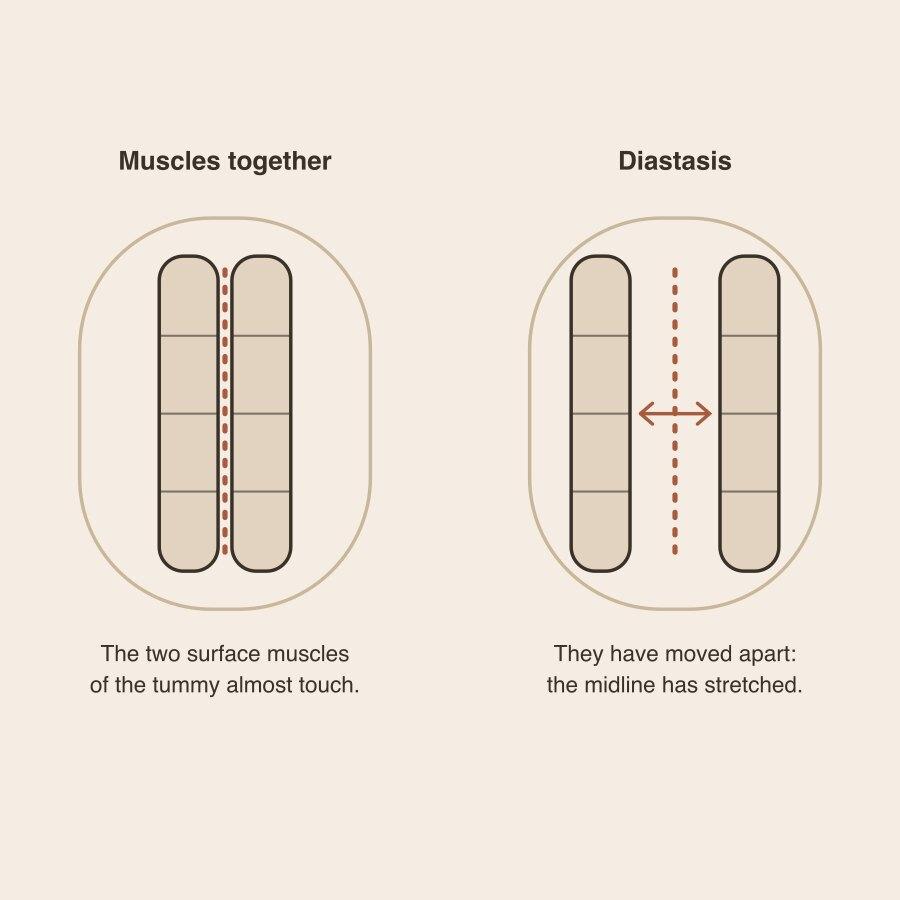
The two outer tummy muscles move apart during pregnancy; the band that joins them down the middle stretches. I measure the gap and assess your transversus, the deep tummy muscle.
See how I treat →My back or pelvis has hurt since the birth, especially when I carry my baby
Postnatal back and pelvic pain
Carrying your baby, bending over them and feeding them all load your back and pelvis while your tummy muscles are still recovering from the pregnancy. We start with posture, your transversus and stabilising exercises.
See how I treat →I want to start running again
Returning to sport
With every impact, pressure rises in your tummy and your pelvic floor has to absorb it. We build up to it step by step, right through to the movements of your sport.
Read the article →Does this sound like you? The first session is there to understand what is going on.
Call 112 or go to A&E, and do not drive yourself, if you have: pain in both legs, loss of strength, numbness between your legs or around your anus, difficulty passing urine or controlling your bowels. During pregnancy and after the birth: sudden breathlessness, chest pain, feeling faint, losing consciousness or a seizure.
During pregnancy, get advice straight away from your doctor, your midwife or the maternity unit if you have: bleeding, fluid leaking, painful contractions before 37 weeks, a baby who is moving less than usual or has stopped moving, a severe headache or problems with your vision, pain below your ribs on the right, a high fever, a swollen and painful leg on one side only.
After the birth, see your doctor or midwife first if you have: heavy bleeding, a fever, a scar that is red, swollen or oozing, pain or swelling in your lower leg. The full list is further down, under “When to see a doctor first”.
The first session
1 hour · €85
After a birth, the first session is a one-hour assessment. I start by explaining how it will go and asking what you hope for. Nothing happens without your agreement.
We talk
Your gynaecological history: periods, miscarriages, contraception, difficulty conceiving. Your pregnancy: the problems you had, the supplements you took. Your birth: vaginal or caesarean, with or without forceps, with or without an epidural, at term or not. Breastfeeding. And how you are finding your new life as a mother.
We fill in a questionnaire
It covers your bladder, your bowel, the support of the pelvic organs and your sex life. It gives a score: that is the starting point, and the treatment plan follows from it. We repeat it at the review session, then at the end. I tell you the reason for each question.
I explain
We go back over your goals. Then the anatomy, how your tummy muscles, diaphragm and pelvic floor work together, and the part posture plays in daily life and in sport. So that you understand the treatment and take part in it.
I examine you
The diastasis, meaning the gap between the two outer tummy muscles. The transversus, the deep tummy muscle. The pelvic floor: its endurance and its quick contractions.
The internal examination is done only with your agreement. You can put it off to a later session, decide not to have it, or stop it at any moment: the decision is yours. I do not do it before four weeks after the birth.
If you come during pregnancy
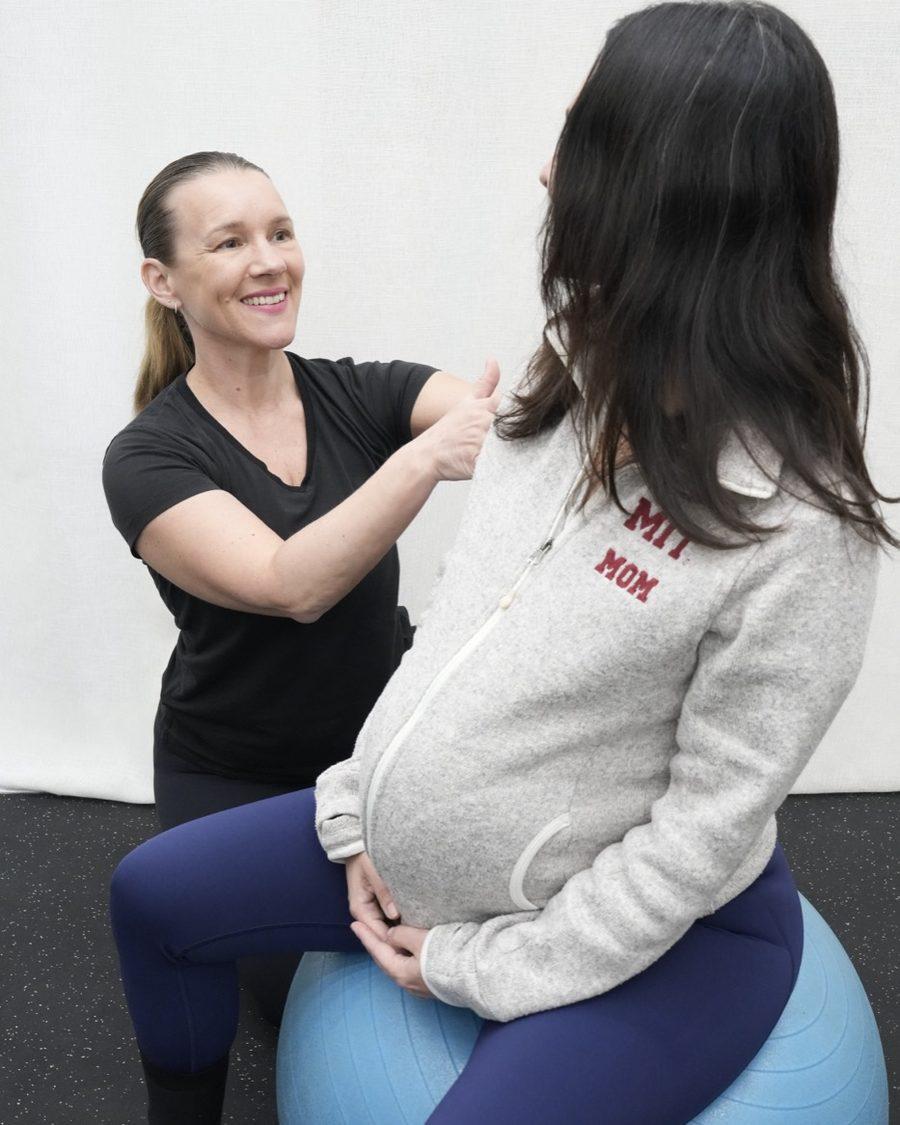
During pregnancy, much of the session is given to explaining how your body is changing, and you leave with tools to ease the pain at home, alone or with your partner. Electrical stimulation, radiofrequency and hypopressive exercises are not used during pregnancy.
What to bring
- Wear something comfortable: loose clothes or sportswear.
- Bring a bottle of water if you like. Everything else is provided.
- Your baby is welcome.
During pregnancy
Back, pelvis, sciatica, preparing your perineum and preparing for the birth
During pregnancy, the first session also lasts an hour. We get to know each other: I try to understand what brings you, and I explain what physiotherapy can offer you to get through this stage as well as possible. I ask you about the common discomforts of pregnancy, so that you don't forget any of them. Then we decide together where to start, based on what you are going through.
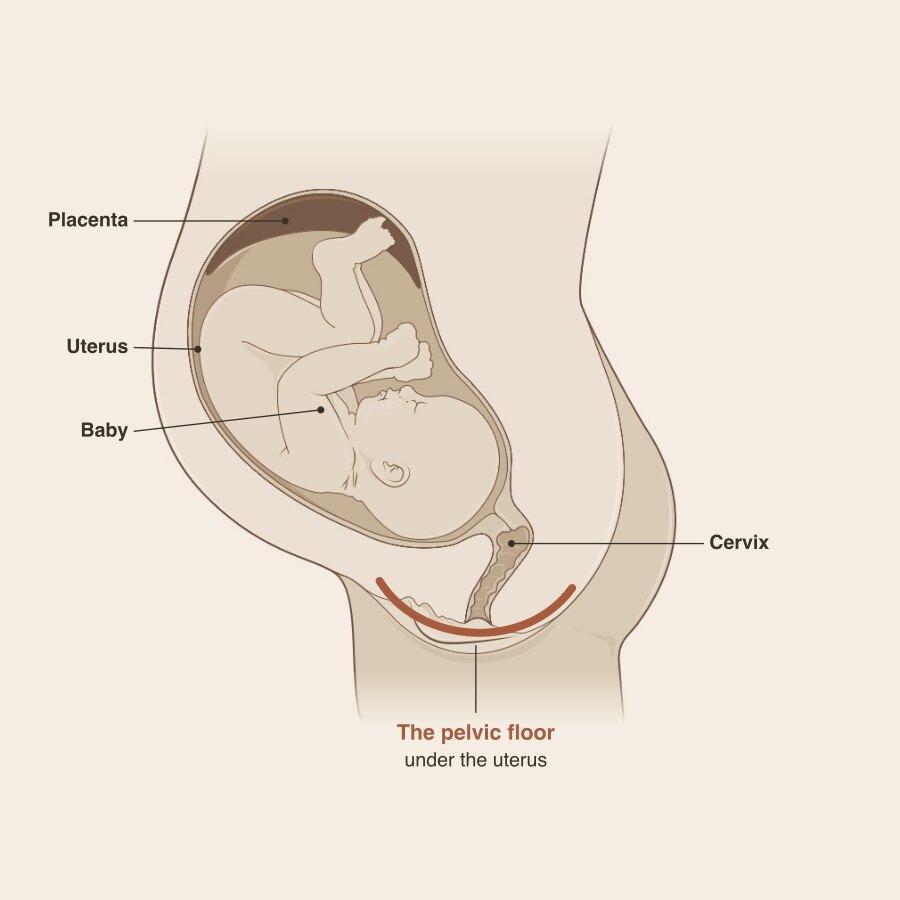
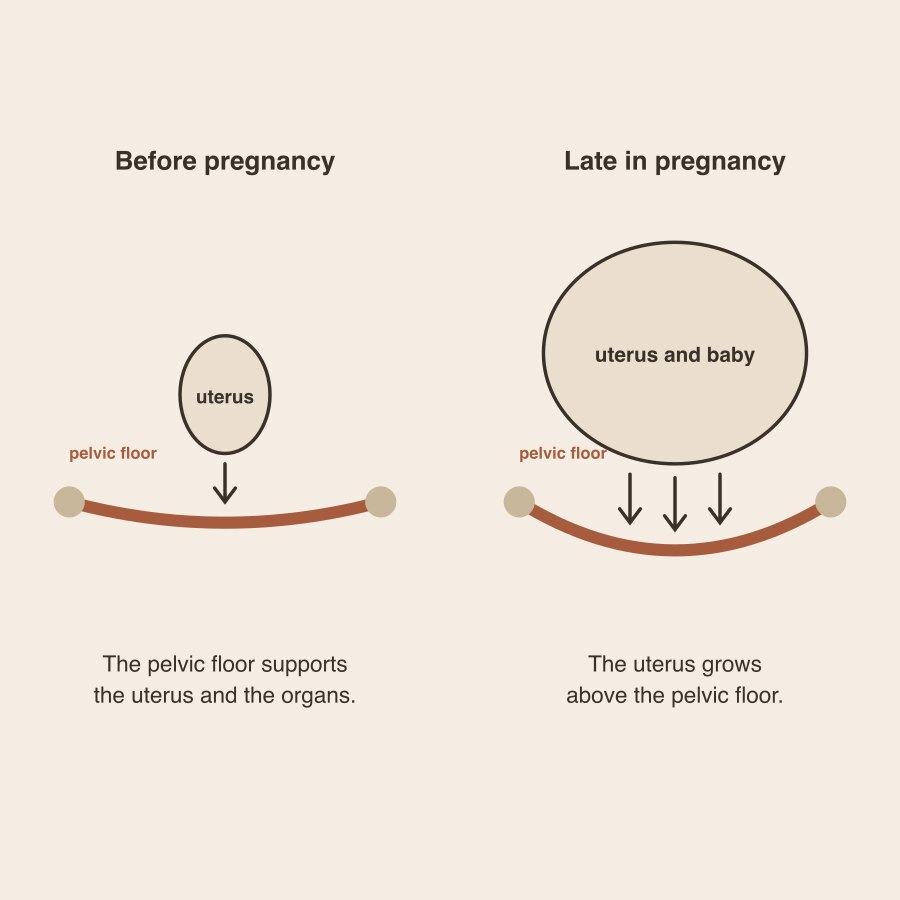
It is important to become aware of your pelvic floor, your posture and your breathing before the birth. Here is what can be done, in the order it comes during pregnancy.
From the start
Becoming aware of your pelvic floor, your posture and your breathing. In women who do not yet have leaks, training the pelvic floor early in pregnancy can prevent leaks from starting late in pregnancy and after the birth.
Throughout the pregnancy
Easing your back, your pelvis or sciatica: manual therapy, mobility work, pregnancy massage, taping, relaxation, and tools for home.
From around week 35
Perineal massage, every day if possible, alone or with your partner.
The last few weeks
Physical preparation for the birth: different ways of breathing, relaxation, mobility.
Back and pelvis. Pelvic pain often lasts until the birth; treatment can ease it during the pregnancy.
Sciatica. I see women for this pain.
What you can do at home for your back and pelvis
In the session, you are given tools suited to your situation. In the meantime, here is some simple advice:
- stay active, without pushing through what hurts;
- sleep with a pillow between your legs;
- sit down to get dressed;
- keep your knees together when getting out of the car;
- bend your knees to pick something up, and wear flat shoes.
Back pain with a fever, bleeding or pain when you pass urine: see your doctor or the maternity unit first. Pain in both legs, loss of strength, numbness between your legs or around your anus, difficulty passing urine or controlling your bowels: call 112 or go to A&E, and do not drive yourself.
After the birth
When to come, how often, after a caesarean, diastasis
After the birth, I see you for an assessment whenever you wish; the internal examination waits until four weeks after the birth. Rehabilitation then begins at your own pace: your tiredness, your time, what you feel like doing. It is never too late.
The pace fits around you. After a birth, I often suggest two sessions a week for a month, then one. Follow-up sessions last 45 minutes. I do not set a number of sessions in advance: at the fifth, we repeat the assessment, with the same score as at the start. Sometimes that is the last one, because you are doing well.
- You learn exercises suited to you, to repeat at home. We start from the basics and add load little by little.
- At home: about ten minutes a day at first. Many of the exercises can be done while your baby naps.
- Between sessions, you can message me on WhatsApp for the whole of the treatment. I reply within 24 hours.
- The treatment ends when your goals are reached and you know how to keep up on your own what you have gained.
After a caesarean
Your pelvic floor is affected too: it is weakened during pregnancy, and above all by the birth. The assessment also looks at your scar and your tummy muscles. After a caesarean, treatment goes ahead with the agreement of your surgeon or gynaecologist.
Diastasis
Diastasis is the gap between the two outer tummy muscles. For many women it narrows on its own during the first year. At the assessment, I measure the gap and assess your transversus, the deep tummy muscle.
A lump in the middle of your tummy or near your belly button that gets bigger when you cough and smaller when you lie down may be a hernia: show it to your GP first.
How I treat
Preparing your perineum, back and pelvis, scars, a weakened pelvic floor, diastasis
According to your needs, never as a routine. The treatment depends on what the assessment has shown.
- Preparing your perineum for the birthGetting your perineum ready for the birth
- Awareness of your pelvic floor and massage, inside and outside the vagina, during the last few weeks. You repeat it at home, alone or with your partner.
- Lower back pain and pelvic girdle painBack and pelvis that hurt during pregnancy
- Manual therapy, pregnancy massage, mobility work, taping (stretchy adhesive strips placed on the skin), relaxation, and tools to ease the pain at home, alone or with your partner.
- Sciatica in pregnancyA pain that runs from your bottom down your leg
- The same basis as for the back: manual therapy, mobility work, and tools to ease the pain at home.
- Physical preparation for the birthLearning to breathe and to let go
- Different ways of breathing, relaxation, mobility, awareness of your pelvic floor.
- Caesarean, episiotomy or tear scarA scar that pulls, feels hard or hurts
- Scar massage and tissue mobilisation; radiofrequency (Indiba) if needed, a gentle deep warmth.
- Pelvic floor weakened after the birthA pelvic floor that has lost strength
- Exercises suited to you, to repeat at home: we start from the basics, then add load little by little.
- Diastasis rectiA gap between the two outer tummy muscles
- I measure the gap and assess your transversus, the deep tummy muscle. Then gradual exercises for the transversus.
Some tools are used only when they help:
- Electrical stimulation, when the pelvic floor is weak: a light current that makes it work.
- Biofeedback (NeuroTrac), to see your contraction on a screen and learn to feel it.
- Radiofrequency (Indiba), on a scar, if needed.
- Hypopressive exercises, after the birth, as an addition: posture and breathing exercises, from four weeks after a vaginal birth and six weeks after a caesarean.
Electrical stimulation, radiofrequency (Indiba) and hypopressive exercises are not used during pregnancy.
What the studies say about these methods
- Perineal massage: for a first vaginal birth, it spares one woman in fifteen from stitches; the effect is mainly on episiotomy (Beckmann and Stock, 2013).
- Pelvic floor training during pregnancy: in women who do not yet have leaks, training early can prevent leaks from starting late in pregnancy and after the birth (Woodley et al., 2020). The studies available do not show that it makes the birth harder: across 16 studies, the second stage of labour, from full dilation to the birth, was about twenty minutes shorter, with fewer severe tears. Most of these studies have weaknesses (Sobhgol et al., 2020).
- Back and pelvis during pregnancy: two reviews of studies give two measures. In the first, women who exercise have less severe pain, but not less often (Davenport et al., 2019). In the second, an 8 to 12 week programme reduces by a third the number of women with back or pelvic pain (Liddle and Pennick, 2015).
- Manual therapy and pregnancy massage: in the studies, they ease pain more than usual care, but no more than a sham treatment (Hall et al., 2016). Single trials find a benefit when they are combined with exercise and information (Liddle and Pennick, 2015).
- Taping: two reviews of trials find less severe lower back pain during pregnancy; the evidence is of low quality (Xue et al., 2021; Chen et al., 2021).
- Breathing and relaxation: classes that teach them seem to increase confidence during labour and might reduce the use of an epidural (Leutenegger et al., 2022). Progressive muscle relaxation also reduces lower back pain (Chen et al., 2021).
- Sciatica: research on sciatica in pregnancy on its own is thin; studies group it with lower back and pelvic pain.
- Back and pelvis after the birth: compared with no exercise, postnatal exercise, including strengthening the trunk muscles, reduces back and pelvic pain and the limits it causes; moderate-certainty evidence (Ruchat et al., 2025).
- Scar mobilisation: two small studies look at the caesarean scar. The scar is more supple after mobilisation; in one, of 32 women and without a control group, it tolerates pressure better (Gilbert et al., 2022; Olszewska et al., 2024).
- Radiofrequency (Indiba): for the caesarean scar, no trial has finished; a French trial of 120 women is under way (Grampayre et al., 2025).
- Electrical stimulation: added to exercises, it does better than exercises alone on urinary symptoms in the first months (17 trials; Zhu et al., 2022). The French College of Gynaecologists and Obstetricians does not recommend it on its own (Deffieux et al., 2015).
- Diastasis: in the main follow-up study, a gap of two finger-widths counts as diastasis; 60% of women have one six weeks after the birth, 33% a year after (Sperstad et al., 2016). Women with a diastasis have no more leaks and no more back pain than others (Sperstad et al., 2016; Bø et al., 2017). Tummy exercises narrow the gap by 4 to 6 millimetres on average according to two reviews, less than the width of a finger; the more recent one sees other possible benefits (Gluppe et al., 2021; Benjamin et al., 2023).
- Hypopressive exercises: in a 2026 trial of 44 women, twelve weeks of hypopressives did not reduce the diastasis; tummy muscle function, body image and pelvic floor symptoms improved (Moreira et al., 2026).
- When to start after the birth: in France, the College of Gynaecologists and Obstetricians recommends pelvic floor rehabilitation when urine leaks persist three months after the birth, and for bowel leaks. It does not recommend it in the first two months, nor for a woman with no symptoms; the evidence for these two points is weak (Deffieux et al., 2015). In the UK, the guideline encourages women to train their pelvic floor during pregnancy and after the birth, without setting a date (NICE, 2021).
When to see a doctor first
Warning signs during pregnancy and after the birth, what I do not promise
During pregnancy, see your doctor, your midwife or the maternity unit first, without waiting, if you have:
- unexplained bleeding;
- fluid leaking from your vagina, even without pain;
- regular, painful contractions before 37 weeks;
- your baby is moving less than usual, or has stopped moving, from what you can feel: call the maternity unit straight away;
- severe tummy pain, sudden or that does not go away;
- a severe, unusual headache, problems with your vision or flashing lights in front of your eyes, pain below your ribs on the right, especially with a headache or nausea, sudden swelling of your face, hands or feet;
- a blood pressure problem, or a concern about your baby's growth;
- a high fever, with feeling more and more unwell;
- a leg that is swollen, red or painful on one side only;
- sudden breathlessness, chest pain, feeling faint, losing consciousness or a seizure: call 112;
- back pain with a fever, bleeding or pain when you pass urine.
During pregnancy and after: pain in both legs, loss of strength, numbness between your legs or around your anus, difficulty passing urine or controlling your bowels: call 112 or go to A&E, and do not drive yourself.
After the birth, see your doctor or midwife first if you have:
- unexplained or heavy bleeding, a fever, sudden severe pain, blood in your urine or stools;
- a scar that becomes redder, more painful and swollen, or that leaks pus or a bad-smelling fluid;
- pain or swelling in your lower leg, a cough or breathlessness; with breathlessness or chest pain, call 112;
- a severe headache, problems with your vision or sudden swelling, in the weeks after the birth.
- I do not do an internal examination before four weeks after the birth, or if you have an infection.
- After a caesarean or any other operation, treatment goes ahead with the agreement of your surgeon or gynaecologist.
- I do not make medical diagnoses: I work with your doctor, your midwife, your gynaecologist. If what you are going through is beyond my field, I refer you to the right professional.
- I do not use electrical stimulation or radiofrequency (Indiba) if you have a pacemaker, or hypopressive exercises if you have a heart condition.
- I do not do home visits.
What I do not promise. Perineal massage does not ensure an intact perineum. No exercise programme is certain to close a diastasis. The effect of Indiba on a caesarean scar has not yet been measured.
Prices, insurance, address
€85 for the assessment, €75 for follow-up · no referral needed · Carrer del Bruc 145
- First session, assessment
- 1 hour · €85
- Follow-up session
- 45 minutes · €75
Do I need a referral? No. You can book directly.
What about insurance? I work privately, outside insurers' networks. You pay for the session and I give you an invoice. Your private or international health insurance then refunds you in full, in part or not at all: it depends on your policy.
Carrer del Bruc 145, 08037 Barcelona (Eixample). Monday to Friday, 9 am to 8 pm. I see patients in French, Spanish, English and Portuguese.
How I work
Nothing without explanation, nothing without your consent · your pace · my training
- I do nothing without explaining it to you first, and nothing without your consent. You can withdraw it at any moment during the session.
- The session is a place to be heard: what you have been through, what you feel, what you fear. No taboos, and with respect for your privacy.
- What is said in the session stays confidential. You have no reason to feel ashamed of your body, or of how you are experiencing your pregnancy or motherhood.
- After a birth, the drop in hormones makes you more sensitive. Be gentle with yourself.
- I respect your pace: your tiredness, your time, what you feel like doing.
- We always start gently. Then we progress together.
- The aim is for you to manage on your own. I stay available if you need support or motivation.
- I offer nothing revolutionary: techniques gained through my training and my years of experience, adapted to each patient, and grounded in research.
- Physiotherapist, qualified at ISEK, Brussels (2004)
- Master's degree in pelvic floor rehabilitation, Spain (2023)
- Low Pressure Fitness certification, hypopressives (2020)
- Registered with the Col·legi de Fisioterapeutes de Catalunya, no. 18060
- Twenty years of practice in France, Belgium, Brazil and Spain
Frequently asked questions
When should I come after the birth? And after a caesarean? Does perineal massage help?
- How early in pregnancy can I come?
- Whenever you wish. It is important to become aware of your pelvic floor, your posture and your breathing before the birth. Started early in pregnancy, pelvic floor training can prevent leaks in women who do not yet have them.
- When should I start after the birth?
- After the birth, I see you for an assessment whenever you wish; the internal examination waits until four weeks after the birth. Rehabilitation then begins at your own pace.
- How long does pelvic floor rehab take after the birth?
- I set neither a length nor a number of sessions in advance. I often suggest two sessions a week for a month, then one. At the fifth session, we repeat the assessment, with the same score as at the start; sometimes it is the last one. The treatment ends when you know how to keep up on your own what you have gained.
- Which pelvic floor exercises should I do after the birth?
- UK guidance encourages them after the birth, without setting a date (NICE, 2021). The NHS describes two: squeeze the muscles around your vagina, urethra and anus and hold for up to 10 seconds, then relax; squeeze and let go straight away. Aim for 10 of each, at least three times a day, without pulling in your tummy and breathing normally. At the assessment, I examine your pelvic floor's endurance and its quick contractions; you leave with exercises suited to you, which we build up step by step.
- I had a caesarean: is my pelvic floor affected?
- Yes: the pelvic floor is weakened during pregnancy, and above all by the birth. In a study that followed 3,763 women for twelve years, 40% of those who had given birth only by caesarean had urine leaks. The assessment also looks at the scar and the tummy muscles.
- I have no symptoms: should I still come?
- Nothing obliges you to. The French College of Gynaecologists and Obstetricians does not recommend routine rehabilitation when there are no symptoms. An assessment tells you where your pelvic floor and tummy muscles stand; sometimes that is enough.
- Does perineal massage before the birth help?
- Yes, for a first vaginal birth: of 15 women who do it during the last few weeks, one avoids stitches (episiotomy or tear); the effect is mainly on episiotomy. For women who have already had a vaginal birth, it does not change the risk of tearing, but they have less pain three months after.
- How do you do perineal massage?
- Preparing the perineum is part of the sessions late in pregnancy. The guidance from the Royal College of Obstetricians and Gynaecologists: from week 35, every day if possible, alone or with your partner; an oil, for example almond or olive oil; your thumbs press towards the anus and towards the sides of the vagina for about a minute, until you feel a stretch; then a U-shaped movement over the lower half of the vagina, for two to three minutes. If your doctor or midwife has asked you to avoid anything inside the vagina, ask them first.
- Will strengthening my pelvic floor make the birth harder?
- The studies available do not show that. Across 16 studies, in women who trained their pelvic floor during pregnancy, the second stage of labour (from full dilation to the birth) was about twenty minutes shorter, and severe tears were less common. Most of these studies have weaknesses.
- Should I buy an Epi-No?
- The studies give no reason to buy one: the Epi-No, a balloon inflated in the vagina to stretch the perineum, has been tested in two trials that contradict each other. The larger one, of 660 women, finds no protection of the perineum; on ultrasound, injuries to the anal sphincter were slightly more common with the device (21% against 14%), a difference that may be due to chance. Its authors conclude that it is unlikely to be useful (Kamisan Atan et al., 2016).
- When can I massage my caesarean scar?
- With the agreement of your doctor or midwife. A French reference point: a trial under way includes women whose scar is still painful six to eight weeks after the birth, and self-massage is the usual treatment from that point. Scar massage is part of the session.
- My caesarean scar itches, is raised or sunken, even years later: what should I do?
- A scar can itch, pull or be uncomfortable, and can take up to two years or more to fade (NHS). If it is thick and raised but stays within the wound, it is a hypertrophic scar: it often flattens over time. If it is hard, smooth, grows beyond the wound and itches while it grows, it is a keloid, more common in people of African or Asian origin, and during pregnancy. If it is sunken, it is called atrophic. If it bothers you, show it to your GP: they may suggest silicone gels or dressings, steroids, freezing (cryotherapy) or laser; removing a keloid with surgery is not usually advised, because it often grows back bigger. If it is red, warm, swollen or leaking pus: see a doctor without waiting.
- Will my diastasis close?
- For many women it narrows on its own during the first year: 60% have one at six weeks, 33% at one year. Tummy exercises narrow the gap by a few millimetres according to two reviews, and the more recent one sees other possible benefits. We measure the gap at the assessment, then again during the treatment. In the follow-up studies, women with diastasis have no more leaks and no more back pain than other women.
- How do I know if I have diastasis recti?
- The NHS describes a simple check: lying on your back, knees bent, you lift your shoulders slightly and feel with your fingertips for the gap between the muscles, above and below your belly button; in the main follow-up study, a gap of two finger-widths between the two outer tummy muscles counts as diastasis. The most visible sign: the middle of your tummy rises to a peak when you sit up, for example to get out of bed or the bath (NHS). At the assessment, I measure this gap and assess your transversus. A lump that gets bigger when you cough and smaller when you lie down may be a hernia: show it to your GP first.
- Which exercises help a diastasis?
- At the assessment, I measure the gap and assess your transversus, the deep tummy muscle; then come progressive transversus exercises. The NHS suggests one to start with: lying on your side, gently draw in your lower tummy, hold for a count of 10, and repeat up to 10 times. Studies do not show that curl-ups (crunches) make the gap worse: in a trial of 70 women, twelve weeks of head lifts and curl-ups did not widen it and made the tummy muscles stronger (Gluppe et al., 2023).
- Does a diastasis need surgery?
- That is a decision to make with your GP and a surgeon. European guidelines from abdominal wall surgeons define diastasis as a gap of more than 2 cm, and suggest physiotherapy may be considered before an operation; their evidence is of limited quality (European Hernia Society, 2021). A lump in the middle of your tummy that gets bigger when you cough may be a hernia: show it to your GP first.
- I have sciatica in pregnancy: can you help?
- Yes, I see women for this pain. Research on sciatica in pregnancy on its own is thin; what has been studied is lower back and pelvic pain, which exercise can ease; one trial also finds a benefit when manual therapy, exercise and information are combined. Pain in both legs, loss of strength, numbness between your legs or around your anus, difficulty passing urine or controlling your bowels: call 112 or go to A&E, and do not drive yourself. If only one leg is swollen, red or painful, see your doctor or the maternity unit without waiting; with breathlessness or chest pain, call 112.
- My pubic bone hurts late in pregnancy: is it a sign that labour is near?
- Not on its own. The signs that labour has begun, as the NHS describes them, are contractions, a show (the plug of mucus coming away), your waters breaking, backache and an urge to open your bowels. Pubic pain is not harmful to your baby, and most women who have it can have a vaginal birth. Regular, painful contractions before 37 weeks, your waters breaking, bleeding or a baby moving less than usual: call the maternity unit.
- Can my partner come?
- The tools I give you to ease pain at home can be done alone or with your partner.
- Can I bring my baby?
- Your baby is welcome. Breastfeeding is one of the questions in the assessment.
- How much is a session? Is it covered by insurance? Do I need a referral?
- The first session lasts an hour and costs €85; the next ones last 45 minutes and cost €75. No referral needed. You pay for the session, I give you an invoice, and your health insurance refunds you according to your policy. I work outside insurers' networks (Adeslas, Sanitas or others): before you come, ask yours whether it refunds a physio outside its network, up to what amount per session, and for how many sessions a year.
- When can I start running or swimming again?
- Every woman has her own timeline: the professionals surveyed in 2024 advise at least three weeks of rest, then a medical and physical check before any return, and a build-up that alternates walking and running, with strength work. Three weeks is a minimum of rest; the date you go back is decided after the assessment. Leaks during effort, a feeling of heaviness or of a lump in the vagina, pain: slow down and let's talk about it. After a caesarean, the NHS advises a daily walk, then going back to other activities once they no longer feel uncomfortable, often at around six weeks. For swimming, an NHS hospital advises waiting until the bleeding after the birth (lochia) has stopped, any wound has healed and your pelvis no longer hurts.
What the research says
Nineteen sources, what they show and what they do not
Here are the main studies consulted, with what they show and their limits.
46 trials, 10,832 women. The authors note that after a birth, about one woman in three has urine leaks, and up to one in ten has bowel leaks. In women without leaks, pelvic floor training started early in pregnancy reduces the risk of leaks late in pregnancy and in the months that follow. In women who already have leaks, no effect has been shown. After the birth, the effect on persistent leaks is uncertain.
Woodley SJ et al. Pelvic floor muscle training for preventing and treating urinary and faecal incontinence in antenatal and postnatal women. Cochrane Database of Systematic Reviews, 2020.
4 trials, 2,497 women. One woman in 15 avoids stitches, one in 21 an episiotomy, only for a first vaginal birth; “mainly episiotomies”, the authors write. No difference in tears, leaks or sex life. Well accepted.
Beckmann MM, Stock OM. Antenatal perineal massage for reducing perineal trauma. Cochrane Database of Systematic Reviews, 2013.
1,527 women. Ten minutes a day from week 34 or 35. First birth: intact perineum in 24% against 15%. Three months after a first birth, no difference in pain or leaks; after a previous vaginal birth, less perineal pain (94% pain-free against 86%).
Labrecque M, Eason E, Marcoux S et al. Randomized controlled trial of prevention of perineal trauma by perineal massage during pregnancy. American Journal of Obstetrics and Gynecology, 1999;180:593-600. And: Labrecque M, Eason E, Marcoux S. Randomized trial of perineal massage during pregnancy: perineal symptoms three months after delivery. American Journal of Obstetrics and Gynecology, 2000;182:76-80.
11 trials, 3,467 women. A fifth fewer episiotomies and tears, and fewer severe tears: on this last point, it contradicts the 2013 review.
Abdelhakim AM et al. Antenatal perineal massage benefits in reducing perineal trauma and postpartum morbidities. International Urogynecology Journal, 2020.
16 studies, 2,829 women. Second stage of labour 21 minutes shorter, fewer severe tears; no difference in episiotomy or caesarean. Moderate to high risk of bias in most of the studies.
Sobhgol SS et al. The effect of antenatal pelvic floor muscle exercises on labour and birth outcomes. International Urogynecology Journal, 2020.
34 trials, 5,121 women. More than two women in three have lower back pain, nearly one in five pelvic pain. Exercise may reduce back pain (low-quality evidence); an 8 to 12 week programme reduces by a third the number of women affected.
Liddle SD, Pennick V. Interventions for preventing and treating low-back and pelvic pain during pregnancy. Cochrane Database of Systematic Reviews, 2015.
Narrative review. Softer ligaments, weight gain, centre of gravity moved forward: the curve of the lower back deepens and the pelvis tips forward.
Casagrande D, Gugala Z, Clark SM, Lindsey RW. Low back pain and pelvic girdle pain in pregnancy. Journal of the American Academy of Orthopaedic Surgeons, 2015;23(9):539-549.
32 studies, 52,297 women. Exercise does not make this pain less frequent; it makes it less severe.
Davenport MH et al. Exercise for the prevention and treatment of low back, pelvic girdle and lumbopelvic pain during pregnancy. British Journal of Sports Medicine, 2019.
37 studies. Compared with no exercise, postnatal exercise, including strengthening the trunk muscles, reduces back and pelvic pain and the limits it causes (moderate-certainty evidence).
Ruchat SM, Beamish N, Pellerin S et al. Impact of exercise on musculoskeletal pain and disability in the postpartum period: a systematic review and meta-analysis. British Journal of Sports Medicine, 2025;59(8):594-604.
Guidelines of the French College of Gynaecologists and Obstetricians. Rehabilitation recommended if urine leaks persist at three months, with at least three supervised sessions, and for anal incontinence. Not recommended in the first two months or without symptoms: low-level evidence.
Deffieux X et al. Recommandations du CNGOF sur la rééducation périnéale et abdominale du post-partum. Journal de Gynécologie Obstétrique et Biologie de la Reproduction, 2015.
Encourage pelvic floor training during pregnancy and after the birth. Consider a supervised three-month programme from week 20 if there is a family history, and after an assisted (instrumental) birth or an injury to the anal sphincter.
NICE. Pelvic floor dysfunction: prevention and non-surgical management (NG210), 2021.
3,763 women followed for twelve years. Urine leaks are less common after caesareans only, but 40% of these women still have them.
MacArthur C et al. Exclusive caesarean section delivery and subsequent urinary and faecal incontinence: a 12-year longitudinal study. BJOG, 2011.
48 studies. Persistent pain: 15% at three months, 9.5% at six months, 5% at one year; usually mild or moderate.
Wang LZ et al. Incidence of chronic postsurgical pain after caesarean delivery: a systematic review and meta-analysis. Anaesthesia, 2025.
5,802 vaginal births in France. Genital or pelvic pain (from the lower tummy to the perineum) two months after: 12.8%, about one woman in eight; from 5.9% with no tear to 38.9% after a tear of the anal sphincter.
Rollet C, Chantry AA, Viaud M et al. Persistent Genito-pelvic Pain 2 Months after Vaginal Birth: A Nationwide Population-based Analysis from the 2021 French National Perinatal Survey. Anesthesiology, 2026, published online ahead of print.
300 women. Diastasis (a gap of at least two finger-widths): 60% at six weeks, 45% at six months, 33% at one year. No more back pain in the women affected.
Sperstad JB et al. Diastasis recti abdominis during pregnancy and 12 months after childbirth. British Journal of Sports Medicine, 2016.
The same group of women as the previous study. Those with a diastasis do not have a weaker pelvic floor, or more leaks or prolapse.
Bø K, Hilde G, Tennfjord MK, Sperstad JB, Engh ME. Pelvic floor muscle function, pelvic floor dysfunction and diastasis recti abdominis: prospective cohort study. Neurourology and Urodynamics, 2017;36(3):716-721.
Professional opinion (118 in the first round, 95 in the last). At least three weeks of rest, then an individual timeline; a medical, psychological and physical check is recommended before returning to running.
Christopher SM et al. Clinical and exercise professional opinion of return-to-running readiness after childbirth. British Journal of Sports Medicine, 2024.
70 women with diastasis, 6 to 12 months after the birth. Twelve weeks of head lifts and curl-ups (crunches), five days a week, neither widened nor narrowed the gap; the outer tummy muscles became stronger and thicker. No clear effect on leaks or on back or pelvic pain.
Gluppe SB, Ellström Engh M, Bø K. Curl-up exercises improve abdominal muscle strength without worsening inter-recti distance in women with diastasis recti abdominis postpartum: a randomised controlled trial. Journal of Physiotherapy, 2023;69(3):160-167.
Guidelines from eight European surgeons, two of them from Spanish hospitals. Diastasis defined as a gap of more than 2 cm. The complaints most often reported are body image and a less stable trunk. Physiotherapy may be considered before surgery. Evidence of limited quality: most recommendations are weak.
Hernández-Granados P et al. European Hernia Society guidelines on management of rectus diastasis. British Journal of Surgery, 2021;108(10):1189-1191.
Limit: only the abstracts of these studies were read. The pregnancy warning signs are the ones I use; those for after the birth and the advice for home come from NHS pages, and the perineal massage technique from a page by the Royal College of Obstetricians and Gynaecologists (RCOG). The points on scars, swimming, diastasis and the signs that labour has begun also come from NHS pages and one NHS hospital.