
My vagina has felt dry since the menopause
After the menopause, falling oestrogen makes the tissues of the vulva and vagina thinner and drier, and bladder leaks become more common. Hormone treatment is decided with your doctor; pelvic floor physiotherapy works on the leaks, and it is never too late.
What is happening
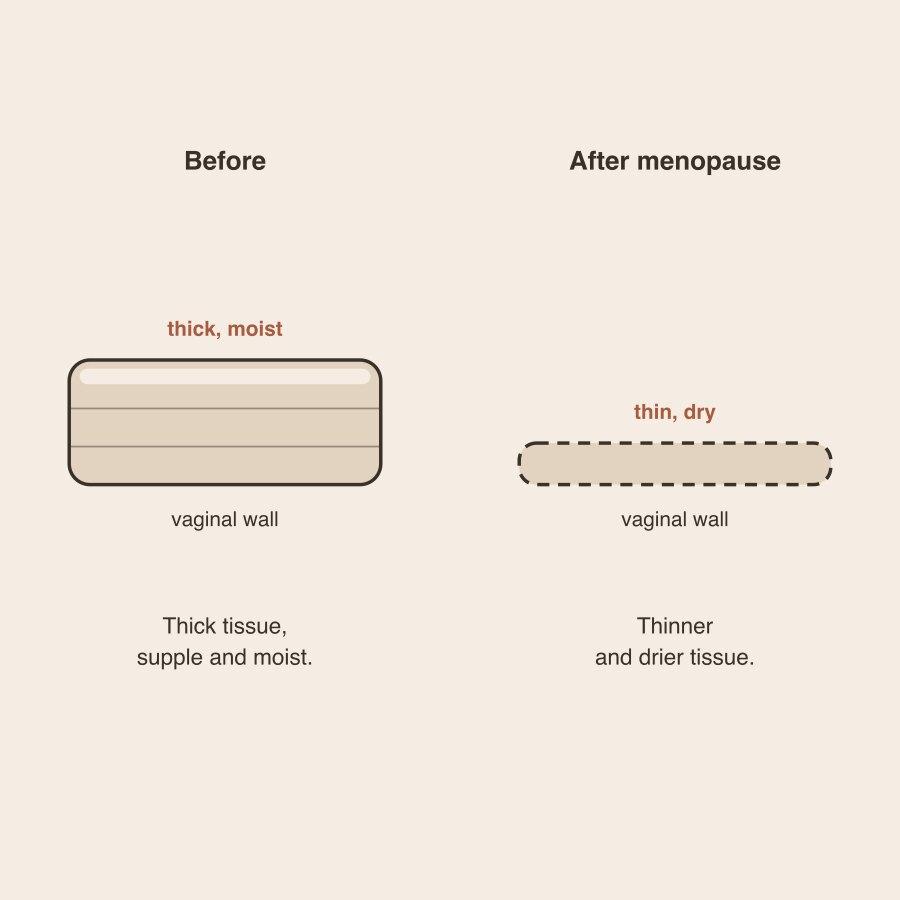
After the menopause, the body makes much less oestrogen. The tissues of the vulva, vagina, urethra and bladder depend on it: they become thinner and drier. This group of changes has a name, the genitourinary syndrome of menopause (it used to be called vulvovaginal atrophy). It can bring:
- dryness, burning or itching of the vulva and vagina;
- less lubrication and pain during sex;
- sudden urges to pee, stinging when you pee, urine infections that keep coming back.
Bladder leaks are also more common after the menopause. A feeling of heaviness or a bulge in the vagina has another cause, prolapse: an organ that has dropped. An examination tells them apart. These problems are common, but they are not normal.
What you can do today
The NHS advises:
- a water-based lubricant before sex;
- a moisturiser made for the vagina, used inside it;
- unperfumed soap for intimate washing, and no douching.
When to see a doctor first
Important: bleeding after the menopause or after sex, or unusual discharge, needs your GP or gynaecologist first. See them too if the dryness has lasted a few weeks despite this advice, or if it affects your daily life, if the skin of your vulva has a sore, itching that does not go away or a change in appearance, or if you have stinging when you pee with a fever.
What about hormone treatment?
For dryness caused by hormone changes, a doctor may prescribe oestrogen as a cream, gel, patch or tablets. It is not suitable for every woman. This choice sits outside physiotherapy: your GP or gynaecologist decides it with you.
How I treat it
For this treatment I see women only. We start with a one-hour assessment. I listen to you, then I measure the strength and endurance of your pelvic floor. The internal examination is never compulsory: the decision is yours.
What follows depends on what bothers you. For leaks: guided pelvic floor strengthening (Kegel exercises), for strength and endurance, and learning the right moment to tighten. For pain during sex: relaxing first, with breathing, manual therapy and gentle, gradual massage. We also work on your breathing, your posture and the transversus (the deep tummy muscle).
At the menopause, I usually suggest one session a week. I don't set a number of sessions in advance: at the fifth, we do another assessment. The treatment ends when you can keep up on your own what you have gained. If a question goes beyond the pelvic floor, such as lower desire, we talk about it openly, and I refer you to the professional best placed to help.
Kegel exercises: am I doing them right? →
Pelvic floor physiotherapy: the first session, prices, my methods →
What the research says
The term “genitourinary syndrome of menopause” was adopted in 2014 by two North American medical societies; it groups genital, sexual and urinary signs linked to falling oestrogen (Portman et al., Menopause, 2014). In a trial of 58 postmenopausal women, eight weeks of supervised, progressive pelvic floor training, on top of education, reduced vulvovaginal and urinary signs and the burden of leaks more than education alone, and pelvic floor strength increased; the trial is small and has no long-term follow-up (Taşkıran et al., Menopause, 2026). A review of 5 trials and 268 women finds that Kegel exercises improve quality of life related to urinary signs; for sex life no difference is shown, and no trial measured genital signs (Nguyen et al., Journal of Nursing Research, 2024). Another review of 5 trials concludes that pelvic floor training reduces bladder leaks after the menopause, with results that vary widely from trial to trial (Marcellou et al., European Journal of Obstetrics & Gynecology and Reproductive Biology, 2025). The practical advice and warning signs come from the NHS (“Vaginal dryness” page, 2025, and the “Vulval cancer” and “Urinary tract infections” pages).