
After giving birth: crunches or hypopressives for my tummy muscles?
The two do not work the same muscles. Hypopressives engage the deep tummy muscles and the pelvic floor and, on average, do not raise the pressure in the abdomen; crunches engage the rectus abdominis and raise that pressure, yet worsened neither the diastasis nor the pelvic floor in a trial of 70 women. The order and timing are decided at the first session.
What is happening
During a crunch, when you lift your head and shoulders, the rectus abdominis (the surface muscles of the tummy) contracts and the pressure in the abdomen rises. In 17 women measured after giving birth, this pressure reached 43% of that of a cough. The pelvic floor, meanwhile, contracted only a little: 29% of its voluntary contraction.
During a hypopressive exercise, you breathe out fully, hold your breath, then open your ribs as if breathing in, without letting air in. In the same women, the pressure in the abdomen did not rise, and the pelvic floor contracted at 51% of its voluntary contraction. On ultrasound, the transversus and the internal oblique (the deep muscles that wrap around the abdomen) thicken during the exercise; the rectus abdominis does not change.
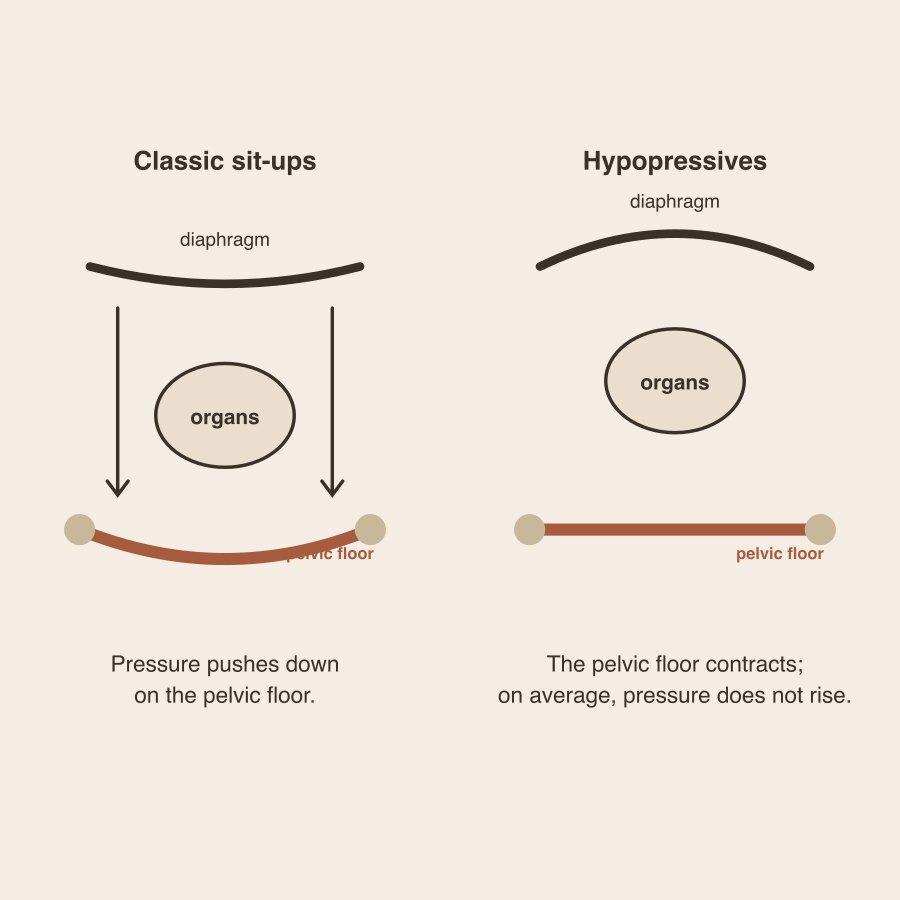
A note on the name: in a 2026 study of 36 women, the pressure did not rise, but it did not clearly fall either.
What crunches do not do
You often read that they open up a diastasis and damage the pelvic floor. One trial followed 70 women who had a diastasis, six to twelve months after giving birth. After twelve weeks of curl-ups, five days a week, the gap had neither narrowed nor widened, pelvic floor symptoms had not changed, and the tummy muscles were stronger. This trial says nothing about the very first weeks after the birth.
What hypopressives do not do
They do not replace pelvic floor rehabilitation: for leaks or a prolapse, two trials out of three find direct pelvic floor training more effective. Nor did they reduce the diastasis in a trial of 44 women.
When to start
After the birth, pregnancy no longer rules out breath-holds. I see you from four weeks after a vaginal birth and six weeks after a caesarean.
When to seek help
Leaks, a feeling of heaviness in the vagina or pain need a pelvic floor assessment first. Sharp, sudden pain, fever or unexplained bleeding need a doctor first.
How I treat it
I look at the pelvic floor, the transversus and the diastasis. We start with the basics, breathing and posture, then increase the load, step by step. If you want to go back to regular ab exercises, we look together at how your tummy and your pelvic floor respond during the effort.
Hypopressive exercises: the first session, prices, what the studies say →
What the research says
The pressures during a crunch and during a hypopressive exercise were measured in 17 women after giving birth (Djivoh and De Jaeger, Neurourology and Urodynamics, 2023), then in 36 women (Saraiva and McLean, Physiotherapy, 2026). The thickening of the deep muscles was observed in 99 students (Da Cuña-Carrera et al., Medicina, 2021). The curl-up trial covers 70 women (Gluppe et al., Journal of Physiotherapy, 2023), the trial on hypopressives and diastasis 44 women (Moreira et al., Brazilian Journal of Physical Therapy, 2026). These are small studies.