
I always need to pee and can’t hold it in
That pressing urge has a name: overactive bladder. As a first treatment, the guidelines suggest retraining the bladder and changing a few habits, before medication.
What is happening
The bladder sends its signal in several stages. A first signal says it is filling: you can wait. A second says it is time to go. With an overactive bladder, the urge is pressing from the very first signal, sudden and strong, and waiting becomes hard.
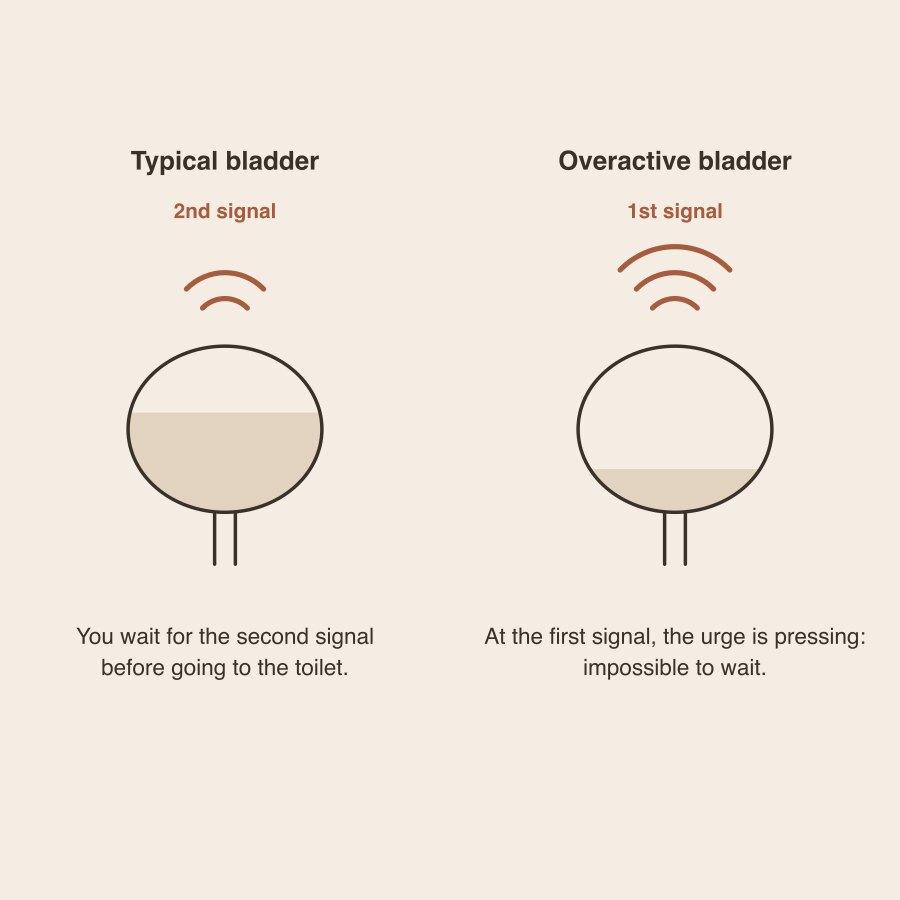
You need a wee very often, sometimes several times a night. Sometimes only a few seconds pass between the urge and the leak: this is urge incontinence (leaking with a sudden, pressing urge). A change of position or the sound of running water can be enough to set it off. Doctors call needing to go more often than usual frequency, and waking at night to pass urine nocturia.
These are not the leaks when you cough or laugh, although the two often come together (mixed incontinence). There are several possible causes, and the mechanism is still poorly understood. Several factors can play a part: falling hormones at the menopause, some metabolic disorders, bowel problems, and anxiety or depression, which are more common alongside an overactive bladder.
It is not necessarily for ever: symptoms can go away, stay the same or come back, and treatment can improve them.
In pregnancy, needing to pee more often, without pain, is common from the first weeks. If you have burning, a fever or blood in your urine, ask your GP or midwife for advice quickly.
What you can do today
- Drink enough: drinking very little doesn’t solve anything.
- Try cutting down on caffeine (coffee, tea, caffeinated fizzy drinks) to see whether your urges change.
- Don’t go to the toilet “just in case”.
- For three days, including a work day and a day off, write down what you drink and when you pass urine (a bladder diary). Your habits show up at a glance.
When to see a doctor first
Important: see your GP first if you have blood in your urine, burning when you pass urine or a fever, urine infections that keep coming back, bladder pain that doesn’t go away, or difficulty emptying your bladder. The same applies if you have a neurological condition, or suspect you might.
How I treat it
For this treatment I see women only. Overactive bladder also affects young women who have never had children. We start with a one-hour assessment. The questionnaire gives a score for your bladder: it is the starting point for tracking your progress. Then we look at your habits: what you drink, and when you go to the toilet.
I then explain the right habits: not going “just in case”, drinking enough and preventing constipation. What comes next depends on what the assessment shows.
I don’t set a number of sessions in advance. At the fifth, we do another assessment; sometimes it is the last one.
Pelvic floor physiotherapy: the first session, prices, my methods →
What the research says
Overactive bladder is a group of symptoms with several possible causes, and its mechanism is still poorly understood (Peyronnet et al., European Urology, 2019).
The NICE guideline (NG123) recommends bladder training for at least six weeks as the first treatment for urge or mixed incontinence: learning, step by step, to leave more time between trips to the toilet. It also advises trying to cut down on caffeine and keeping a bladder diary for at least three days. These recommendations date from 2006 and are still current.
A Cochrane review of 15 trials and 2,007 adults finds that bladder training may clear or improve symptoms 1.4 times as often as anticholinergic medicines (4 trials, 258 people), with fewer side effects. The evidence is still of low to very low certainty (Funada et al., Cochrane, 2023).
For pelvic floor muscle training, the main Cochrane review has only one trial on urge incontinence alone, with no data on cure (Dumoulin et al., Cochrane, 2018).
Over time: 75 women with an overactive bladder were followed for six and a half years by questionnaire; symptoms went away in 40% and stayed stable in 41% (Heidler et al., Neurourology and Urodynamics, 2011). Of 53 women referred to a specialist hospital unit and re-examined ten years later, 88% still had an overactive bladder muscle (Garnett et al., BJU International, 2009). A review of 11 observational studies finds that anxiety and depression are more common alongside an overactive bladder; it shows a link, not a cause (Melotti et al., International Neurourology Journal, 2017). The factors listed above come from Peyronnet's review; the pregnancy advice from NHS pages.