
I leak when I cough, laugh or run
It is common, and you don't have to live with it. Most often, the pelvic floor no longer closes the urethra firmly enough when pressure rises in the tummy. A pelvic floor can be retrained, at any age.
What is happening
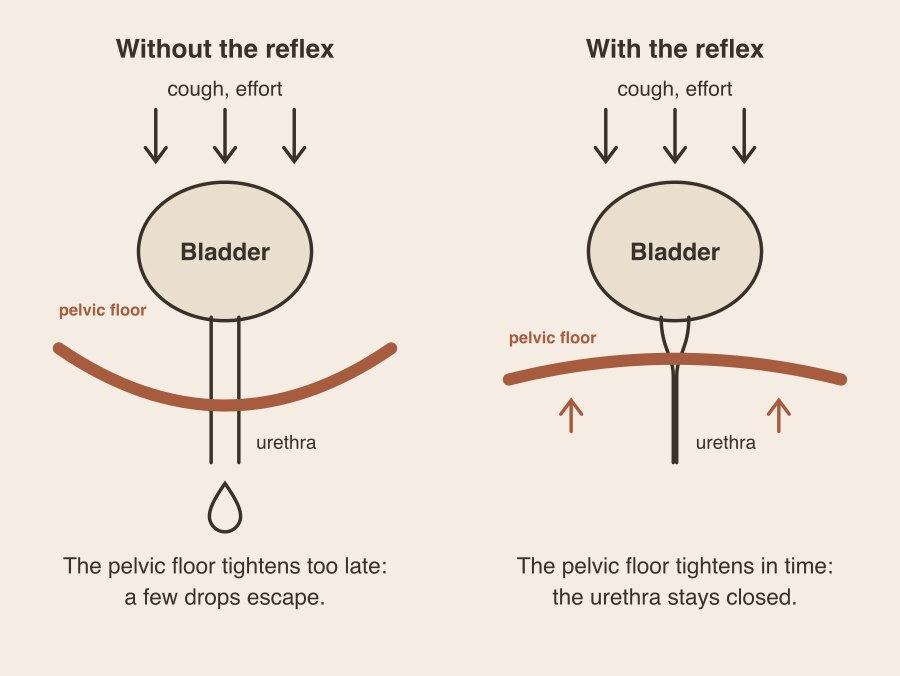
When you cough, laugh or jump, pressure in your tummy rises suddenly. Your pelvic floor (the muscles that close the bottom of the pelvis) then has to squeeze the urethra, the tube that urine passes through. If it squeezes too late or not hard enough, a few drops escape. This is called stress urinary incontinence.
Another kind of leak comes with a sudden, strong urge to wee, or just after it: this is urge incontinence. It usually comes from a bladder that contracts too much (overactive bladder). The two kinds can mix: this is called mixed incontinence.
I always need to pee and can’t hold it in →
What you can do today
- Breathe in and tighten your pelvic floor just before you cough or lift something.
- Don't push or strain on the toilet.
- Drink enough: drinking less doesn't solve anything.
When to seek help
As soon as the leaks bother you or make you give up an activity. See your GP first if there is blood in your urine, a fever, or sudden severe pain.
Leaking while you sleep, without noticing, is a different problem: talk to your GP first, who will look for the cause.
How I treat it
We start with a one-hour assessment that measures the strength and endurance of your pelvic floor. Then comes guided strengthening (Kegel exercises), learning the right moment to tighten, and work on the transversus (the deep tummy muscle), your breathing and your posture. Electrical stimulation or biofeedback are used only if you cannot feel yourself contracting.
Kegel exercises: am I doing them right? →
Pelvic floor physiotherapy: the first session, prices, my methods →
What the research says
Stress urinary incontinence is the most common form in women (Bø, Sports Medicine, 2004). The review brings together 31 trials and 1,817 women. In the four trials that measured cure of stress leaks (165 women), 56% of those who trained their pelvic floor said they were cured, compared with 6% without treatment; follow-up rarely went beyond one year (Dumoulin et al., Cochrane, 2018). Urge leaks usually come from an overactive bladder muscle; the two kinds can occur together (NHS, Urinary incontinence). Passing urine in your sleep without noticing (enuresis) is a different disorder from the urge that wakes you at night; the latter often goes with an overactive bladder (Leslie et al., StatPearls, 2024).