
Hypopressive exercises in Barcelona · Low Pressure Fitness
Hypopressive exercises combine postures and a breathing technique that work the deep tummy muscles and the pelvic floor. Measured during the exercise, the pressure inside the abdomen does not rise, on average. I teach them in Barcelona, in the Eixample, in one-to-one sessions, on their own or alongside pelvic floor rehabilitation.
Is this for me?
Since giving birth, I can't feel my tummy muscles any more
Abdominal wall after pregnancy
During a hypopressive exercise, the deep tummy muscles (the transversus and the internal oblique) contract. The rectus abdominis, the surface muscles, do not change. I start with posture and breathing.
Read the article →I've had a gap between my tummy muscles since my pregnancy
Diastasis recti (separated tummy muscles)
During pregnancy, the two rectus muscles move apart along the midline (the linea alba). The gap often narrows after the birth; in some women, it stays. I measure the gap, then we work on posture, breathing and the deep tummy muscles.
Read the article →I'm finishing my pelvic floor rehab and want to keep it up
Alongside pelvic floor rehabilitation
During the exercise, the pelvic floor contracts without you deciding to, less strongly than in a voluntary contraction. The pelvic floor comes first; hypopressives come alongside it, for posture, breathing and the deep tummy muscles.
See how I treat →The 5 other situations
Hypopressive exercises are first of all for women who have given birth, recently or long ago, and for those who are doing or finishing pelvic floor rehabilitation.
You may recognise yourself in one of these sentences. Select the one that sounds like you.
My tummy pushes forwards or down when I make an effort
Managing pressure
The diaphragm, the tummy muscles and the pelvic floor work together with every breath. On average, the pressure in the abdomen does not rise during a hypopressive exercise. We start with breathing and posture, to learn how to manage pressure during effort.
See how I treat →I've had lower back pain for months
Chronic low back pain
Lower back pain has many causes. During a hypopressive exercise, the deep muscles that wrap around the abdomen contract. The first session shows whether hypopressives have a place; sharp, sudden pain needs a doctor first.
See how I treat →I'd like to get my pre-pregnancy waist back
Waist size
Hypopressives work the transversus, the deep muscle that wraps around the waist. We work on the transversus and posture, with no promise of centimetres.
Read the article →Does this sound like you? The first session shows whether hypopressives suit you, and where to start.
Are you pregnant?
I do not use hypopressives during pregnancy. Work on posture, breathing and awareness of the pelvic floor is still possible, without breath-holds.
Do you have a cardiovascular problem or high blood pressure?
I do not use hypopressives if you have a cardiovascular problem, or when another physical or psychological condition rules them out. If you have high blood pressure, ask your doctor before you start.
The first session
1 hour · €75
The one-to-one Low Pressure Fitness session lasts an hour and costs €75. If you are coming only for hypopressives, the full assessment (1 hour, €85) is offered, not required: we can start straight away with the session.
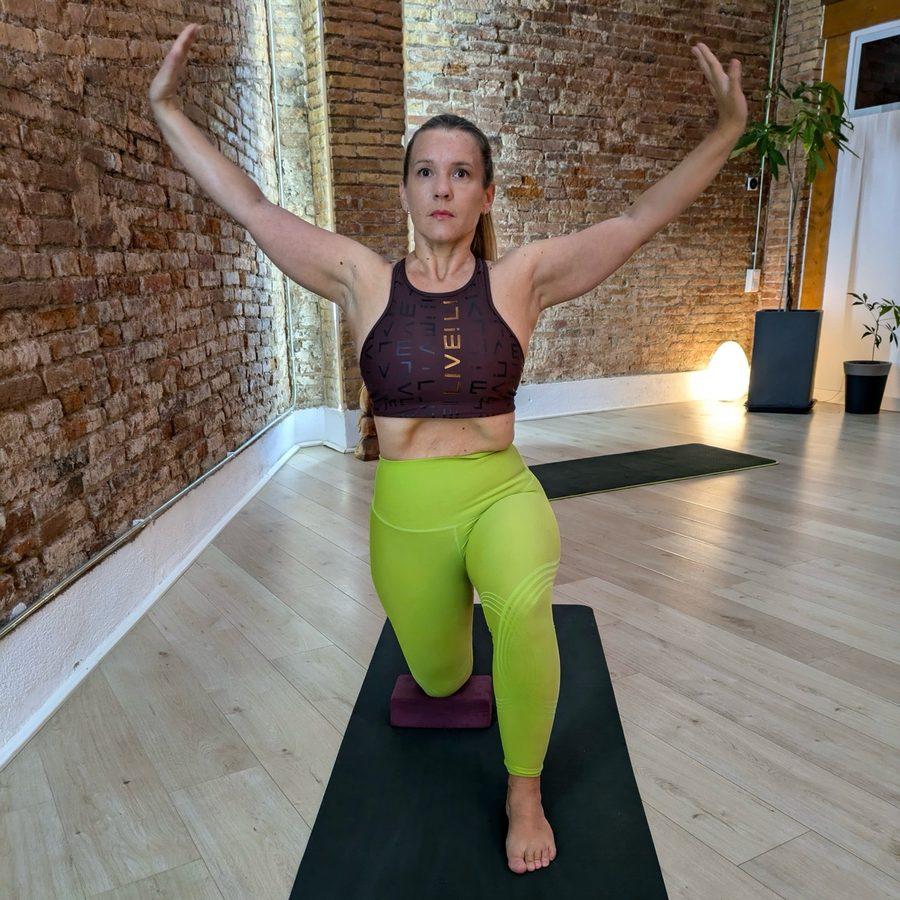
We talk
I explain how the session will go, then I listen: what brings you and what you hope for. Then I ask you a few questions about your births if you have had any, your sport and your health. Tell me if you are pregnant, or if you have a cardiovascular problem or high blood pressure.
I look
At your posture, your breathing and your abdominal wall. If there is a diastasis, meaning a gap between the two surface muscles of the tummy, I measure it.
You learn the breathing
Breathe in by opening the ribs, breathe out slowly and fully. Then comes the breath-hold: lungs empty, you open your ribs as if breathing in, without letting air in.
We try the first postures
Lying down, then sitting or standing, lengthening your spine. I choose the postures and their order according to your level and your goals.
At the end of the session
You leave with your first exercises to repeat at home.
What to bring
- Wear something comfortable: loose clothes or sportswear.
- Bring a bottle of water if you like.
After the first session
How often, practising at home
I do not set a number of sessions in advance, and I do not promise a timescale. My role is to make you independent: able to practise on your own.
The exercises go from the simplest to the most complex.
- At home: at least ten minutes a day.
- Little equipment: a mat is enough. A ball or a resistance band can vary the exercises.
How I treat
Posture, breathing, the breath-hold · what the measurements show · their place alongside pelvic floor rehabilitation
A hypopressive exercise combines a held posture and a breathing technique. You lengthen your spine, you breathe into your ribs, then you hold your breath, lungs empty, while opening your rib cage. This last step is called the false inspiration.
- Intra-abdominal pressureThe pressure in the abdomen: on average, it does not rise during the exercise
- On average, it does not rise during the exercise. It does not clearly fall either, despite the method's name, and the result varies from one woman to another (36 women measured in 2026).
- Transversus and internal obliqueThe deep tummy muscles, the ones that wrap around the abdomen
- They thicken during the exercise, a sign that they are contracting. The rectus abdominis does not change (99 people examined by ultrasound).
- Levator aniThe pelvic floor switches on without you deciding to
- They contract without any voluntary command, less strongly than in a deliberate contraction.
How I use them:
- Alongside pelvic floor rehabilitation, to get the tummy muscles and the pelvic floor working together again.
- After giving birth: from four weeks (vaginal birth) or six weeks (caesarean).
- For posture and breathing.
They do not replace direct pelvic floor training. For leaks when you cough, sneeze or exercise or a prolapse, two trials out of three find that training more effective. In the trials that added hypopressives to pelvic floor training, the pelvic floor gained no extra benefit.
What the trials show for the other reasons people come:
- Diastasis: in a trial of 44 women after giving birth, twelve weeks of hypopressives did not reduce the gap between the rectus muscles any more than no exercise. The tummy muscles did, however, cope better with effort.
- Chronic back pain: in two small trials (20 people per group), pain decreased after eight sessions or eight weeks of hypopressives. In one of the two, it also decreased with massage alone. The effect was only measured in the short term.
- Waist size: the studies that measure it are small and of low quality, and their results contradict each other: some see it go down, one saw it go up.
- Duration: in the trials, programmes last four to twelve weeks, most often with two sessions a week. These figures describe the study protocols.
When it is not suitable
Pregnancy, cardiovascular problems, high blood pressure, after a birth, hernia or abdominal surgery · what I do not promise
- During pregnancy, I do not use hypopressives.
- If you have a cardiovascular problem, or another physical or psychological condition that rules them out, I do not use them either.
- If you have high blood pressure, ask your doctor before you start: hypopressives are traditionally advised against in cardiovascular disease. One measurement has been published, on ten young women with normal blood pressure, seated and already trained: their blood pressure rose during the sets of breath-holds. It says nothing about people with high blood pressure.
- After the birth, pregnancy no longer rules out breath-holds. I see you from four weeks after a vaginal birth and six weeks after a caesarean.
- A hernia or abdominal surgery does not stop you practising: we talk about it at the assessment. After an operation, with your surgeon's agreement.
- The trials do not show that hypopressives close a diastasis, or that they replace pelvic floor rehabilitation.
- I promise neither centimetres off your waist nor a timescale.
- During a breath-hold, if you feel unwell, stop and breathe normally. Chest pain or faintness that persists needs a doctor; sudden, severe pain in the abdomen needs A&E.
- I do not make medical diagnoses. Sharp, sudden pain, fever or unexplained bleeding need a doctor first.
- I do not do home visits.
Prices, insurance, address
€75 for a one-hour session · assessment at €85 if you wish · no referral needed · Carrer del Bruc 145
- One-to-one Low Pressure Fitness session
- 1 hour · €75
- Full assessment, if you wish
- 1 hour · €85
Do I need a referral? No. You can book directly.
What about insurance? I work privately, outside insurers' networks. You pay for the session and I give you an invoice. Your private or international health insurance then reimburses you in full, in part or not at all, depending on your policy. Before you come, ask your insurer three questions:
- Do you cover a physiotherapist outside your network (in Spain: fuera del cuadro médico)?
- Up to what amount per session?
- For how many sessions a year?
Carrer del Bruc 145, 08037 Barcelona (Eixample). Monday to Friday, 9am to 8pm. I see patients in French, Spanish, English and Portuguese.
How I work
Nothing without explanation · gently first · my training
- I do nothing without explaining it first, and nothing without your consent. You can stop an exercise at any moment.
- We always start gently. Then we progress together.
- Every body is different: the work adapts to your age and your history.
- My role is to make you independent: able to practise on your own.
- I offer nothing revolutionary: techniques I have learnt through my training and my years of experience, adapted to each patient, and based on research. When the research is divided, I tell you.
- Low Pressure Fitness certification, hypopressives (2020)
- Master's in pelvic floor rehabilitation, Spain (2023)
- Physiotherapy degree, ISEK, Brussels (2004)
- Registered with the Col·legi de Fisioterapeutes de Catalunya, no. 18060
Frequently asked questions
Do they replace pelvic floor rehabilitation? Do they close a diastasis? When can I start after giving birth?
- What are hypopressive exercises (Low Pressure Fitness)?
- An exercise technique that combines postures and breathing with a breath-hold. It works the deep tummy muscles and the pelvic floor; on average, the pressure in the abdomen does not rise during the exercise.
- Caufriez, Low Pressure Fitness, de Gasquet: what is the difference?
- Hypopressive exercises come from Marcel Caufriez, a Belgian physiotherapist, who created them in the early 1980s for recovery after childbirth. Low Pressure Fitness is a training method founded later by Tamara Rial and Piti Pinsach: it is the one I teach, and I have been certified in it since 2020. Dr Bernadette de Gasquet's method is a different approach: it works the tummy muscles while you breathe out, without a breath-hold.
- How much does a hypopressive session cost?
- The 60-minute one-to-one session costs €75. The full one-hour assessment costs €85; if you are coming only for hypopressives, it is offered, not required.
- Do you run group classes?
- No. I teach hypopressives only in one-to-one sessions, lasting an hour, at €75.
- Do I need a referral? Is it covered by insurance?
- No referral needed. You pay for the session, I give you an invoice, and your health insurance reimburses you according to your policy. Ask your insurer whether it covers a physiotherapist outside its network, up to what amount and for how many sessions a year.
- Do hypopressives replace pelvic floor rehabilitation?
- No. For leaks when you cough, sneeze or exercise or a prolapse, two trials out of three find direct pelvic floor training more effective. I use them alongside it, for posture, breathing and the deep tummy muscles.
- I have a prolapse or a feeling of heaviness: can I do hypopressives?
- A feeling of heaviness in the vagina needs a pelvic floor assessment first. In prolapse rehabilitation, strengthening the pelvic floor comes first; I use hypopressives alongside it, for managing pressure, with breathing, posture and the transversus. In a trial on prolapse, pelvic floor training did better than hypopressives alone.
- What are hypopressive exercises good for?
- They work the deep tummy muscles and the pelvic floor; on average, the pressure in the abdomen does not rise during the exercise. In small trials, after giving birth, the tummy muscles coped better with effort, and body image and pelvic floor symptoms improved; back pain was reduced in the short term. The trials do not show that they close a diastasis, and for leaks or a prolapse direct pelvic floor training does better.
- Do hypopressives close a diastasis?
- The trials do not show it. In a trial of 44 women, twelve weeks of hypopressives did not reduce the gap any more than no exercise. The tummy muscles coped better with effort and pelvic floor symptoms decreased.
- Do hypopressives give you a flat stomach?
- I do not promise it. None of the studies read for this page measures weight loss. Those that measure waist size are small and of low quality, and their results contradict each other.
- How long before you see results?
- It depends on each situation, and I do not promise a timescale. In the trials, programmes last four to twelve weeks, most often with two sessions a week.
- Before and after: what changes?
- I do not promise centimetres or a timescale. In the most direct trial, 44 women did twelve weeks of hypopressives after giving birth: they held the plank 34 seconds longer, their body image had improved and their pelvic floor symptoms had decreased. The gap between the tummy muscles, however, had not narrowed any more than without exercise. On waist size, the studies contradict each other.
- When can I start after giving birth? And after a caesarean?
- After the birth, pregnancy no longer rules out breath-holds. I see you from four weeks after a vaginal birth and six weeks after a caesarean.
- Can I do hypopressives while pregnant?
- No, I do not use them during pregnancy. Work on posture, breathing and awareness of the pelvic floor is still possible, without breath-holds.
- Are there any contraindications?
- I do not use hypopressives during pregnancy, if you have a cardiovascular problem, or when another physical or psychological condition rules them out. If you have high blood pressure, ask your doctor before you start: blood pressure rises during breath-holds, according to a measurement made on ten young women with normal blood pressure. After giving birth, I see you from four weeks (vaginal birth) or six weeks (caesarean). A hernia or abdominal surgery does not stop you practising: we talk about it at the assessment. After an operation, with your surgeon's agreement.
- I am a beginner: how is a hypopressive exercise done?
- In three steps. Posture: you lengthen your spine. Breathing: you breathe in by opening your ribs, then breathe out slowly and fully, three times. The breath-hold: with your lungs empty, you open your ribs as if to breathe in, without letting air in; then you release and breathe normally. The first exercise is learnt in a session, with me. In one study, women had two learning sessions and practised for two weeks before being measured: the movement takes a little time.
- Standing, sitting or lying down: which position?
- We start lying on your back, then sitting or standing. The principle is the same in each position: you lengthen your spine, breathe through your ribs, then comes the breath-hold. I choose the postures and their order according to your level and your goals. In 36 women measured, the pelvic floor contracted slightly more standing (47% of its voluntary contraction) than lying down (37%). In another 30, the deep tummy muscles and the pelvic floor activated just as well lying down, on all fours and standing.
- How many times should I repeat the breath-hold?
- I choose the postures and their order according to your level. In the studies, the numbers vary: in one, the breath-hold came every three breaths, in three sets; in another, each session had five basic postures, repeated three times each. In one trial, the false inspiration, lungs empty, was held for about ten seconds before normal breathing resumed. These numbers describe the study protocols.
- Can I do hypopressives at home?
- Yes, once you have learnt the exercise in a session. You leave with your first exercises to repeat at home, at least ten minutes a day; a mat is enough. Do not try them on your own if you are pregnant, if you have a cardiovascular problem, if you have high blood pressure and your doctor has not agreed, or if you have just given birth or had an operation.
- Hypopressives or regular ab exercises?
- Hypopressives work the deep tummy muscles and, on average, do not raise the pressure in the abdomen. Curl-ups work the rectus abdominis; in a trial of 70 women with a diastasis, they worsened neither the gap nor the pelvic floor. The choice depends on what we see at the first session and on your goals.
- Do hypopressives help with back pain?
- Two small trials on chronic back pain (20 people per group) find less pain after eight sessions or eight weeks of hypopressives; in one of the two, pain also decreased with massage alone, and the effect was only measured in the short term. Sharp, sudden pain needs a doctor first.
What the research says
The main studies, what they show and what they do not
Hypopressives have been studied less than pelvic floor rehabilitation, and the trials are small. Literature reviews judge their quality too low to draw conclusions. Here are the main studies, with what they show and what they do not.
36 women new to the method. During the exercise, the pressure in the abdomen does not clearly fall (by 1 to 3 cmH₂O on average, a difference compatible with zero). The pelvic floor contracts at 37% of its maximum voluntary contraction lying down, 47% standing.
Saraiva S, McLean L. Intra-abdominal pressure and pelvic floor muscle activation observed during hypopressive exercises performed in supine and standing. Physiotherapy, 2026.
99 healthy students, by ultrasound. The transversus and internal oblique thicken during the exercise; the rectus abdominis does not change.
Da Cuña-Carrera I et al. How do the abdominal muscles change during hypopressive exercise? Medicina, 2021.
94 women, eight weeks, followed for a year. Hypopressives, pelvic floor training and the two combined improve symptoms and strength, with no difference between the groups.
Navarro-Brazález B et al. Effectiveness of hypopressive exercises in women with pelvic floor dysfunction. Journal of Clinical Medicine, 2020.
Two twelve-week trials, one on prolapse, the other on leaks when you cough, sneeze or exercise. Both groups improve, and pelvic floor training does better on every measure. For leaks: 1.9 fewer episodes a week, against 0.6 with hypopressives.
Resende APM et al. (2019) and Jose-Vaz LA et al. (2020). Neurourology and Urodynamics.
Review of seven trials on exercise other than pelvic floor training, including hypopressives. Adding hypopressives to pelvic floor training brings nothing more for prolapse, and pelvic floor training is more effective than hypopressives alone.
Bø K et al. Are hypopressive and other exercise programs effective for the treatment of pelvic organ prolapse? International Urogynecology Journal, 2023.
44 women, twelve weeks, two thirty-minute sessions a week, compared with a group doing no exercise. The gap between the rectus muscles does not narrow any more. The plank is held 34 seconds longer, body image improves and pelvic floor symptoms decrease.
Moreira SE et al. Hypopressive exercises for diastasis recti and pelvic floor symptoms in postpartum women. Brazilian Journal of Physical Therapy, 2026.
70 women with a diastasis, six to twelve months after giving birth. Twelve weeks of curl-ups worsen neither the gap nor pelvic floor symptoms, and strengthen the tummy muscles.
Gluppe SB, Ellström Engh M, Bø K. Curl-up exercises improve abdominal muscle strength without worsening inter-recti distance in women with diastasis recti abdominis postpartum. Journal of Physiotherapy, 2023.
Two trials on chronic back pain. The first compares three groups of 20 people (massage, hypopressives, both), with no untreated group: pain decreases in all three, and the combination does better on disability. The second compares 20 people doing eight weeks of hypopressives with 20 people without treatment: pain and disability decrease. The effect is measured in the short term only.
Bellido-Fernández L et al. (Disability and Rehabilitation, 2022) and Vicente-Campos D et al. (Journal of Clinical Medicine, 2021).
Ten young women with normal blood pressure, seated and already trained. Blood pressure rises during the sets of breath-holds and returns to its starting level within five minutes. The study says nothing about people with high blood pressure. Its authors point out that hypopressives are traditionally contraindicated in cardiovascular disease.
de Lucena EGP et al. Hypopressive exercise in normotensive young women: a case series. Journal of Bodywork and Movement Therapies, 2021.
A single case. A 46-year-old man arrives at A&E with sudden abdominal pain and vomiting, which began after he had done hypopressive gymnastics. Imaging shows a rupture of the left diaphragm, with a hernia containing the stomach, the spleen and part of the pancreas. He has surgery. The report says nothing about his medical history or how he practised.
Montilla Navarro E et al. Left diaphragmatic hernia due to muscle rupture after hypopressive abdominal gymnastics. Cirugía Española, 2022.
103 patients preparing for abdominal wall surgery, 77% with a midline hernia. The programme combined nutrition, physical activity (including hypopressive exercises and relaxation) and psychological support; 93% did the hypopressive exercises offered. A retrospective study: it measures whether the programme was feasible, not the effect or the safety of hypopressives.
Joliat GR, Krouk S, Cotte E, Passot G. Implementation of a prehabilitation program before abdominal wall surgery: a pilot and feasibility study. Hernia, 2025.