
Sex is painful
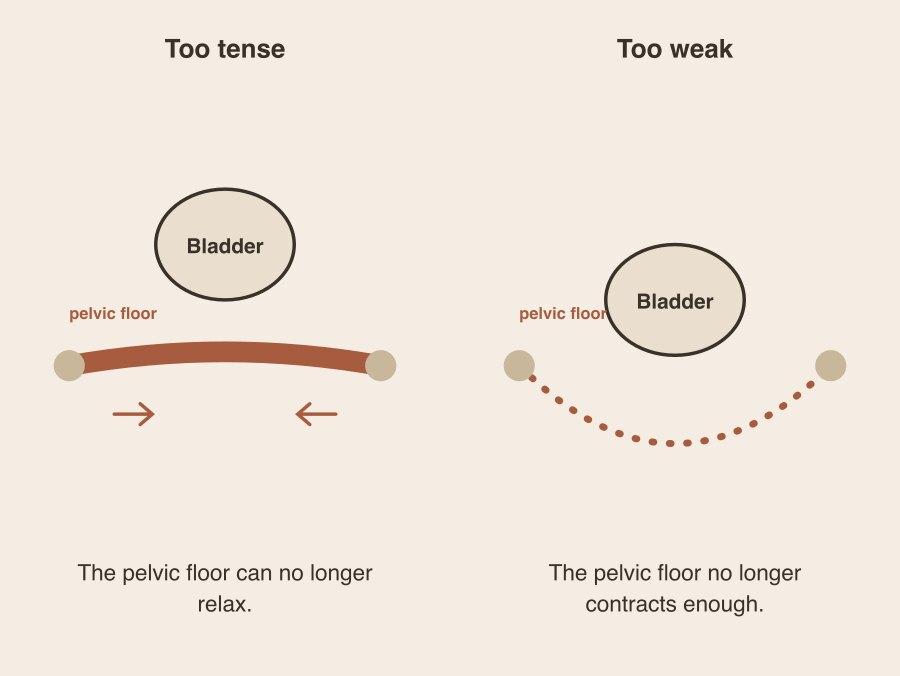
This pain is common, but it is not normal. Often the pelvic floor muscles no longer relax. So we start by relaxing them; strengthening comes later, if needed.
What is happening
Pain during sex (dyspareunia) has several possible causes:
- pelvic floor muscles that are too tight;
- a scar from an episiotomy or a tear;
- tissues that have become thinner and drier, for example at the menopause;
- vaginismus: the muscles around the vagina tighten without you deciding to, and penetration becomes painful or impossible.
What physiotherapy can treat, and what it cannot
A pelvic floor that is too tight, vaginismus, a scar: yes. For other causes, I refer you to the right professional. Unexplained bleeding needs a medical opinion first.
How I treat it
Nothing happens without your agreement, and the internal examination is never compulsory.
The first aim is to relax the pelvic floor; strengthening comes later, if needed. We begin with breathing and releasing the diaphragm, then manual therapy and a gentle, gradual massage. I also work on scars, if there are any. I also use radiofrequency (Indiba), a gentle heat to make the tissues more supple, and pain-relieving electrical stimulation (TENS), which a review links to less pain.
Pelvic floor physiotherapy: the first session, prices, my methods →
Does physiotherapy work?
For pain at the entrance of the vagina (provoked vestibulodynia), yes: a large trial shows it. That trial, run in four Canadian university hospitals, 212 women who had pain at the entrance of the vagina on touch or penetration (provoked vestibulodynia) had either ten physiotherapy sessions, one a week, or an anaesthetic cream. The sessions combined explanations, pelvic floor exercises with a screen to see the muscle working, manual therapy and dilators. Pain during sex fell clearly more with physiotherapy, and the result still held six months later. Eight women in ten felt much better, compared with four in ten with the cream. The authors recommend physiotherapy as the first treatment.
What about endometriosis?
It is treated with your gynaecologist. It often comes with a pelvic floor that is too tight, and that is the part of the pain physiotherapy works on.
What the research says
Across 151 studies, only 15 measures were reliable enough to draw a conclusion: 10 found a tighter pelvic floor, all in pelvic pain, and 5 found no difference. The authors judge this evidence still scarce (Worman et al., American Journal of Obstetrics and Gynecology, 2023). Physiotherapy reduced pain during sex more than an anaesthetic cream, in 212 women, with the effect still present at six months (Morin et al., American Journal of Obstetrics and Gynecology, 2021). A review of 19 studies finds that electrical stimulation, alone or with pelvic floor exercises, reduces pain and improves quality of life (Fernández-Pérez et al., BMC Women's Health, 2023). Manual therapy also relieves pain, but the studies are still few and small (Trahan et al., 2019). In a trial of 34 women with deep endometriosis, five sessions reduced pain at the entrance of the vagina during sex by 3 points out of 10, and slightly reduced chronic pelvic pain; bladder, bowel and sexual function did not change (Del Forno et al., 2021 and 2023).