
Kegel exercises: am I doing them right?
Done well, Kegel exercises reduce leaks when you cough, laugh or exercise. But many women push down without realising it, and a pelvic floor that is too tight first needs to learn to relax.
What is happening
A Kegel exercise is a deliberate contraction of the pelvic floor: the muscles that close the bottom of the pelvis, around the urethra, vagina and anus. Done well, the contraction squeezes without pushing down. Then the muscle lets go completely.
Letting go matters as much as squeezing. A pelvic floor that is too weak no longer contracts enough; a pelvic floor that is too tight no longer knows how to relax.
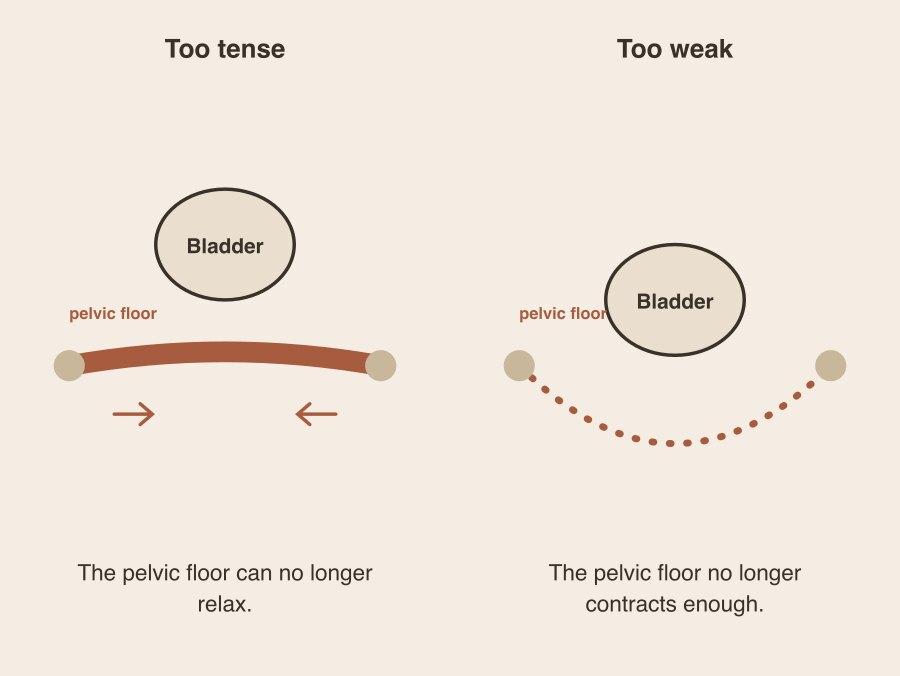
How to do a Kegel exercise
The NHS guidance, in four steps:
- To find the right muscles, imagine you are stopping yourself from peeing and passing wind.
- Squeeze those muscles without pulling your tummy in, and keep breathing normally.
- Hold for 2 seconds, then let go completely.
- Repeat 10 times. Little by little, build the hold up to 10 seconds.
During pregnancy and after the birth, the UK guideline also encourages these exercises, to help prevent pelvic floor problems (NICE NG210, 2021). After 60 too, they reduce leaks: it is never too late. Men do these exercises too; after prostate surgery, their effect on leaks remains uncertain (Johnson et al., Cochrane, 2023).
The most common mistakes
Many women believe they are doing it right and are in fact pushing down. That can make leaks more likely rather than less. A spoken or written explanation is not always enough: in one study, only one woman in two contracted correctly after a short instruction.
A few signs to watch for:
- you hold your breath;
- you pull your tummy in or feel yourself pushing down;
- you can't really feel what is contracting, or you feel nothing;
- you don't fully let go between two contractions.
When the pelvic floor needs to relax first
Strengthening is not always the first step. A pelvic floor that is too tight (a hypertonic pelvic floor) no longer knows how to relax. It often shows as pain, during sex or in the pelvis, and as difficulty passing urine or opening your bowels (Faubion et al., 2012).
In that case, I don't start with strength work: first we learn to relax. The assessment shows which one is yours: one we relax, the other we strengthen.
When to see a doctor first
Important: see your GP first if you have blood in your urine, pain in the bladder or urethra that does not go away, difficulty emptying your bladder, or bowel leaks as well as urine leaks.
How I treat it
For this treatment I see women only. I do nothing without explaining it to you first, and nothing without your consent. At the assessment, which lasts an hour, I measure your pelvic floor with the PERFECT score: the strength of the contraction, graded from 0 to 5, how long you can hold it, how many times you can repeat it, and quick contractions. The internal examination happens only if you agree; without it, I assess the pelvic floor from the outside and with a questionnaire.
If your pelvic floor is weak, Kegel-type exercises are the base: we work on strength and endurance, and you learn to contract just before you cough or make an effort. If you can't feel your contraction, biofeedback shows it to you on a screen; electrical stimulation helps when the contraction doesn't come. If it is too tight, we start with breathing, manual therapy and visualising the pelvic floor.
At home, allow about 10 minutes a day at first. You can film yourself; I correct you between sessions, and you can reach me on WhatsApp. I don't set a number of sessions in advance. At the fifth, we do a new assessment.
Pelvic floor physiotherapy: the first session, prices, my methods →
What the research says
In women with leaks on effort, 56% of those who trained their pelvic floor report being cured, against 6% without treatment (4 trials, 165 women); follow-up rarely goes beyond a year (Dumoulin et al., Cochrane, 2018). After a short spoken instruction, 23 of 47 women made a correct contraction, and 12 used a technique that could make leaks more likely; it is a study without a control group (Bump et al., 1991). The UK guideline offers, as first treatment for stress or mixed incontinence, at least 3 months of pelvic floor training supervised by a professional, with at least 8 contractions 3 times a day (NICE NG123, 2019). In 83 women over 65 with leaks on effort, 20 weeks of intensive pelvic floor training reduced leaks more than bladder training; the trial is small (Sherburn et al., 2011).