
I'm pregnant: should I do perineal massage before the birth?
Yes, for a first vaginal birth: massaging your perineum during the last few weeks lowers the risk of needing stitches, above all the risk of an episiotomy. The effect is modest: one woman in fifteen.
What is happening
The pelvic floor is the group of muscles that closes the bottom of the pelvis. At birth, these muscles and the skin over them, between the vagina and the anus (the perineum), have to stretch to let the baby's head through.
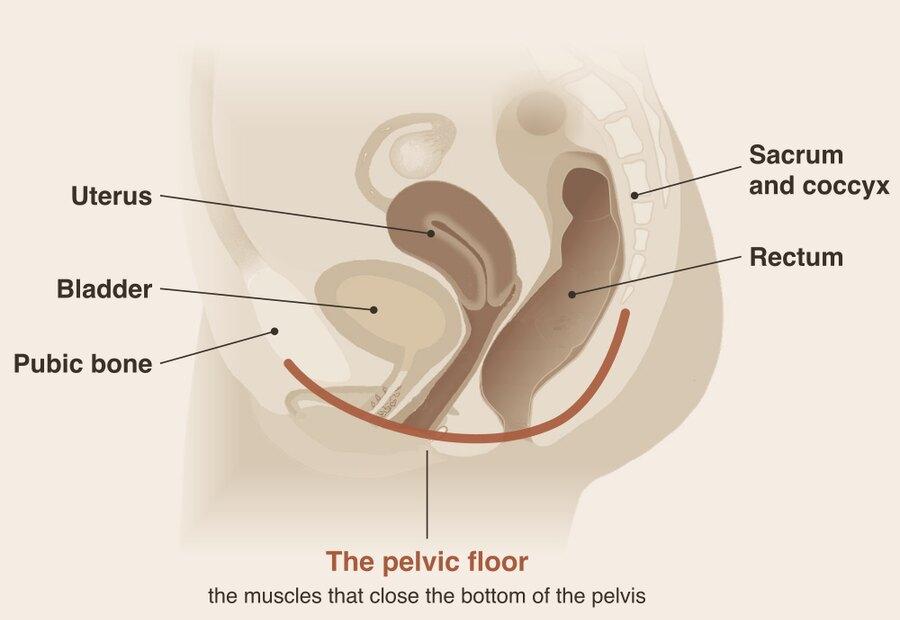
Diagram adapted from R. Whitwam, CC BY-SA 4.0.
What you can expect from it
Of 15 women who massage their perineum before a first vaginal birth, one avoids stitches (episiotomy or tear); the effect is mainly on episiotomy. In the largest trial, for a first birth, 24 women in 100 gave birth with an intact perineum in the massage group, against 15 in 100 without massage. The more regular the massage, the clearer the effect.
What you cannot expect from it
Massage does not ensure an intact perineum. On severe tears, the reviews disagree: the 2013 one (4 trials) finds no difference, the 2020 one (11 trials) finds fewer. On urine leaks, no difference. If you have already had a vaginal birth, it does not lower the risk of tearing; on the other hand, women who did it have less pain three months after.
When to start
In the largest trial, women started at week 34 or 35 of pregnancy, and massaged for ten minutes a day until the birth. The main review counts massage done for at least the last four weeks. The Royal College of Obstetricians and Gynaecologists advises it from week 35.
How to do it
Preparing the perineum includes becoming aware of your pelvic floor and the massage, inside and outside the vagina. You then repeat it at home, alone or with your partner. Here is the guidance from the Royal College of Obstetricians and Gynaecologists:
- an oil, for example almond or olive oil;
- your thumbs press towards the anus and towards the sides of the vagina for about a minute, until you feel a stretch;
- then a U-shaped movement over the lower half of the vagina, for two to three minutes, repeated two or three times;
- every day if possible.
What about the Epi-No?
It is a balloon inflated in the vagina to stretch the perineum. There are two trials and they contradict each other: the first, of 276 women, finds more intact perineums; the second, of 660 women, finds no difference, and on ultrasound notes slightly more injuries to the anal sphincter with the device (21% against 14%), a difference that may be due to chance. Its authors conclude that it is unlikely to be useful. The studies give no reason to buy one.
Before you start
If your doctor or midwife has asked you to avoid anything inside the vagina, or if you are unsure, ask them. Bleeding or fluid leaking needs their advice first.
How I treat it
Preparing the perineum is part of a whole: awareness of your pelvic floor, different ways of breathing, mobility, relaxation. Nothing happens without your agreement.
Pregnancy and postnatal care: the first session, prices, my methods →
What the research says
Across 4 trials and 2,497 women, massage in the last few weeks reduces the number of women who need stitches, mainly from episiotomy, only for a first vaginal birth; it is well accepted (Beckmann and Stock, Cochrane, 2013). A more recent review, of 11 trials and 3,467 women, also finds fewer severe tears (Abdelhakim et al., 2020). Ten minutes a day from week 34 or 35: 24% intact perineums against 15% (Labrecque et al., 1999). Three months after a first birth, no difference in pain or leaks; after a previous vaginal birth, less perineal pain (Labrecque et al., 2000). For the Epi-No: Ruckhäberle et al., 2009; Kamisan Atan et al., BJOG, 2016. For the technique: Royal College of Obstetricians and Gynaecologists, “Perineal tears during childbirth”.