
I have a gap between my tummy muscles: can hypopressives close it?
In the most direct trial, no: in 44 women, twelve weeks of hypopressives did not reduce the gap between the tummy muscles any more than no exercise. They gained something else: tummy muscles that coped better with effort, a better body image and fewer pelvic floor symptoms.
What is happening
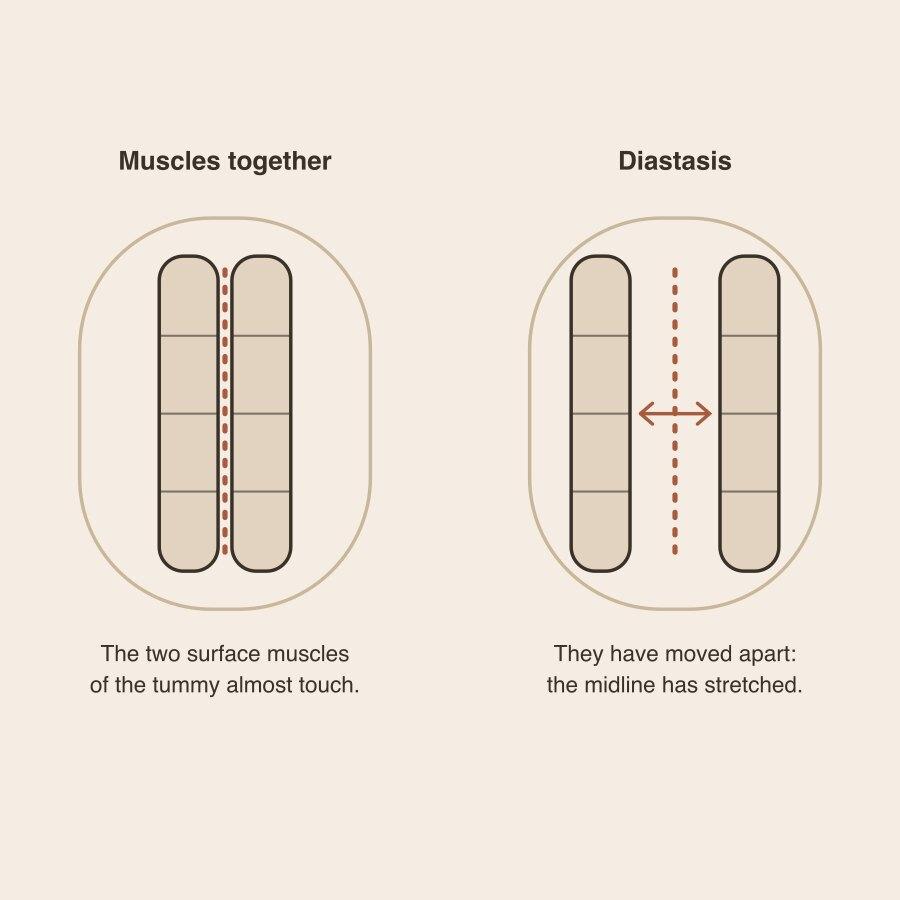
The two rectus muscles, the surface muscles of the tummy, are joined in the middle by a band of tissue, the linea alba. During pregnancy, under the effect of hormones and the mechanical changes in the body, they move apart: this is diastasis recti. The gap often narrows after the birth; in a study of 300 first-time mothers, one in three still had one twelve months later.
What the trials measured
- 44 women with a gap of at least 20 millimetres, between 45 days and 6 months after giving birth. One group did twelve weeks of hypopressives, two thirty-minute sessions a week; the other did no exercise. On ultrasound, the gap did not change differently in the two groups.
- 28 women, six weeks of hypopressives or regular ab exercises. The gap narrowed by about 3 millimetres in both groups, with no difference between them. The trial had no group without exercise.
- 12 women, four weeks of hypopressives, with no comparison group. The gap narrowed.
The two studies that find a reduction had no group without exercise. The one that did have one finds none.
During the exercise
In 46 women examined three months after a first birth, the gap measured during a hypopressive exercise was the same as at rest. The linea alba did not distort. During a curl-up, it distorted more often, and the gap narrowed above the belly button: at those points, it stayed wider during the hypopressive exercise than during the curl-up.
What about other exercises?
The finding holds for exercise in general. A 2026 review of 15 trials and 803 women finds no evidence that exercise alone reduces the gap. Another, in 2025, finds a reduction after abdominal training, with a low level of evidence. In a trial of 70 women, curl-ups did not worsen the gap and strengthened the tummy muscles.
When to see a doctor first
If a lump appears at the belly button, or if the area becomes painful: a lump there can be an umbilical hernia. When the gap stays wide and troublesome despite rehabilitation, surgery is one of the options to discuss with a doctor.
How I treat it
I measure the gap. We work on posture, breathing and the deep tummy muscles, to get the tummy and the pelvic floor working together again during effort. I also look at the pelvic floor and the transversus, the deep tummy muscle.
Hypopressive exercises: the first session, prices, what the studies say →
What the research says
The trial of 44 women is Moreira et al. (Brazilian Journal of Physical Therapy, 2026); in it, the plank was held 34 seconds longer in the hypopressive group. The other studies: Soto-González et al. (PLoS One, 2024), Ramírez-Jiménez et al. (case series, 2023), Arranz-Martín et al. (Physical Therapy, 2022). The reviews: Gluppe, Engh and Bø (2021), who judge the evidence to be of very low quality; Lyons et al. (Hernia, 2026); Beamish et al. (British Journal of Sports Medicine, 2025). The curl-up trial is Gluppe et al. (Journal of Physiotherapy, 2023). How common diastasis is twelve months after the birth comes from Sperstad et al. (British Journal of Sports Medicine, 2016).