
Congested baby: when should I worry?
Rinse your baby's nose first, then watch how they breathe, how much they drink and how they respond. Here are the signs that call for the doctor, and those that call for the emergency services.
What is happening
A young baby can only breathe through the nose. When their nose is full of mucus, feeding and sleeping are hard. When the infection moves down into the small airways, it is bronchiolitis: they cough, breathe fast, and they wheeze. It starts like a cold, and breathing difficulty can appear two to four days later.
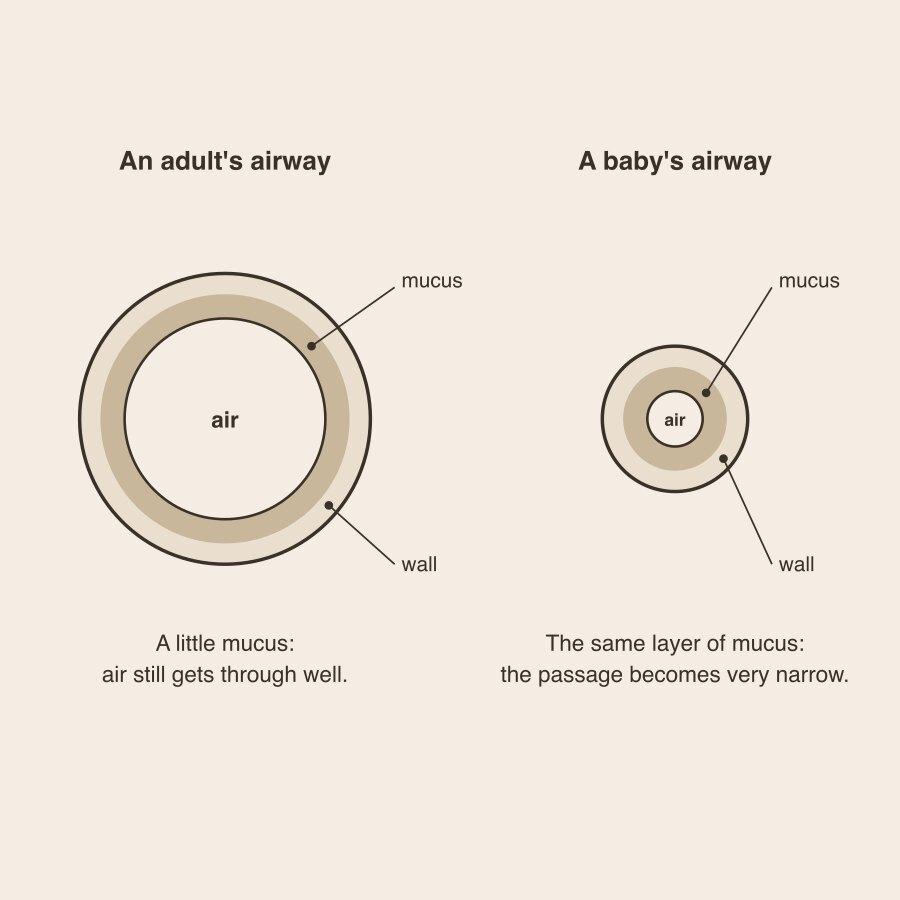
A baby's airways are much narrower than an adult's: the same thickness of mucus leaves far less room for air.
The Spanish sheet for parents asks you to watch their breathing, their feeds, their colour and general state, and their temperature. The signs below come from this sheet and from the one that France's national health authority (HAS) gives to parents.
Call the emergency services
Call the emergency services (112 in Spain, 15 in France) if your baby shows any of these signs. They turn blue around the mouth. They go floppy or seem to pass out. They have pauses in their breathing. Their breathing becomes slow and they still struggle to breathe. They stop responding, are very tired, sleep all the time, or whimper. They refuse their bottles or the breast.
Go to A&E
The Spanish Society of Paediatric Emergencies (SEUP) asks you to go to A&E (urgencias) if your baby's breathing gets worse or faster, if they stop breathing for a few seconds or their lips turn blue or purple, if they struggle with feeds, refuse them or vomit, if their nappy stays dry and their mouth and tongue are dry, if they are very listless or whiny, or if they have a very high temperature.
See the doctor again
See the doctor again if any of these signs persists after a nasal rinse. They are tired, less responsive or very agitated. Their breathing has become faster. They start to struggle to breathe and their chest sinks in. They feed less well over several feeds in a row. France's national health insurance (Assurance Maladie) asks for this new appointment to take place the same day.
Is your baby under two months old, born premature, or living with a condition of the heart, lungs, muscles or immune system? Have them seen by a doctor without waiting.
A baby who has been congested since birth, who is congested without a cold, or who is congested mainly after bottles: show them to their paediatrician.
What you can do today
- Rinse their nose with saline solution, before feeds and before bedtime.
- Offer smaller, more frequent feeds.
- Do not smoke in the room where they are. Keep the bedroom at 19°C.
- Put your baby to sleep on their back, on a firm, flat mattress, as the NHS and France's HAS advise. If you have been told to raise the cot, ask your paediatrician.
- Keep an eye on them, especially in the first two to three days.
How to clear my baby's nose with saline, step by step →
What does not help
Cough syrups and mucus-thinning medicines are contraindicated in babies. Antibiotics are not recommended, unless the doctor finds or strongly suspects a bacterial infection (France's national health authority, HAS, 2019). Coughing helps clear secretions from the airways. Always ask the doctor before giving any medicine to a baby.
How long it lasts
The acute phase of bronchiolitis lasts ten days on average. A mild cough can last up to four weeks. If your child is still struggling to breathe after that, see the doctor again.
How I treat it
I do not make diagnoses and I do not replace the paediatrician or A&E. Once a doctor has examined your baby, the session includes the nasal rinse and learning how to do it. If I see any of these signs during the session, I refer you straight away to the doctor or to A&E.
Respiratory physiotherapy: the session, the price, my methods →
What the research says
The warning signs and durations come from the guideline of France's national health authority (HAS, 2019) and its sheet for parents; the signs for going to A&E come from the sheet of the Spanish Society of Paediatric Emergencies; the same-day timing and the role of coughing come from France's national health insurance. In 367 babies sent home from A&E with bronchiolitis, more vigorous nasal suctioning changed neither the course of the illness, nor feeding, nor sleep compared with minimal suctioning (Schuh et al., JAMA Network Open, 2023).